



The Investor Relations, Communications Strategy Primer for NC Founders Series
Communications as an early stage founder are critical. Your job as founder and CEO is to, yes, build the product and figure out GTM, bust through PMF and start scaling. To get there you can’t just put your nose to the grindstone and focus on that, you have to build your persuasion skills and part of that is communications. If you don’t bring everyone along for the ride (board, advisors, investors, team and customers) along for the journey, the whole thing can fall apart at any minute.
Solving one of those is hard, solving all of them simultaneously creates a world where every step of the way only 1-2% of new startups make it to the next phase.
Why are Founder Comms so important?
Solving all the challenges every startup faces requires a team effort. Your board, investors, advisors are all part of that team. But in this part of the series, we’re going to focus on the most important team - YOUR team.
The way I like to flow comms is what I call a waterfall. It starts with the board update, then rolls into an investor update and then finally becomes the company update. As a non practicing software engineer, my favorite optimization was ‘code re-use’ - Oh, I can re-use this original piece of code here too -boom time saved, 2x value of that code.
What I like about this waterfall comms approach is it gives you ‘content re-use’ - The same content is basically distilled a bit, but largely re-used 3X.
The steps in the comms waterfall also are the article in the series:
IR Comms waterfall step 1: Quarterly Board meetings (Part 1 was here)
Optional: Monthly Board update email - I call these FLASHs
IR Comms waterfall step 2: Quarterly Investor Updates (Part 2 was here)
Optional: Monthly investor updates - also FLASHs
IR Comms waterfall step 3: Team Update and All Hands meeting (Part 3: Coming next week)
We couldn’t share posts like this without our amazing sponsors:


When I Learned the Hard Way to Focus on Team Comms
At ChannelAdvisor we hit a wave and shot from $1-2m ARR to $10-12m ARR quickly, we grew rapidly to 100-120 people - it was awesome and if you modeled it out in Excel, it didn’t stop, you just threw more people against it.
Sadly that didn’t happen, we suddenly slowed to the point of being flat. How’d we try to solve it Add more people! Didn’t work. I decided it was time to get some help, I had never built anything quite this big before having sold before we got to that scale in previous companies. It wasn’t a TAM problem. The executive team seemed dialed in (turns out that was a facade - but that’s a story for another time). But employee churn was running rampant, some of our top performers were leaving.
I found a killer HR person, and bought her in to help. She immediately did an employee survey. The feedback that came back was brutally honest and not good.
Do you like your job? Nope
Do you feel challenged? Nope
Are you appreciated? Nope
Do you understand your role? Nope
Do you know our goals as a company? Nope
Do you believe in the mission? Nope
It was brutal, and I was side swiped because I felt like I was overdoing it with comms. I was sending out emails all the time, I was doing amazing industry analysis, being super transparent and sharing it all in intricate detail.
The HR person was brutally honest: Your a technical founder, I get that, and your emails are good, but they’re too much. People want to see the leader, they want to hear from them, they want to ask you questions, they want to understand. At first I was defensive - well we should hire people that don’t need all this hand holding - wth!
This was an era where everyone was in the office. After sitting with it a while, I realized, I had to 180 my thinking. I was the problem. I’m a natural introvert - I’m perfectly happy being in a dark closet working away at my laptop. As software developers we’re trained to be mushrooms. I had to get out of mushroom-mode, get out there and start meeting everyone 1:1, talking to them, getting to really know them and 100x my comms.
At that point, I ‘shook the box’ hard and we started with weekly Monday Morning Meetings (the MMM!) The good news is it worked and every since then I’ve made team comms foundational to company building. Turns out weekly is ‘too much’ and monthly.
As is the practice in this series, we’ll present some best and worst practices around Company meetings (aka the all hands, aka the town hall, aka the team meeting).
Company Meeting Best Practices
First and foremost, as founder(s), part of your job is to set the tone and build the culture of the company. One of the most major ways that gets expressed is through the company meeting. Therefore there’s an element of this that’s extremely personal and thus, long-tail - you’ll want it to be a perfect match for your vision of the company culture and how you want things to go. What we’re presenting here is our experience across a handful of companies founded in different era’s. Think of it as a starting point to paint with your own brush and preferences.
CMBP 1: Frequency/cadence
Personal experience is weekly is too much, monthly is just right for up to 1000. Past that- YOYO. Quarterly probably isn’t frequent enough unless you are 10 people in an office and everyone is hearing everything. Also in the increasingly virtual workplace, perhaps you feel that the way your internal comms channel (e.g. Slack, Teams, G-workspace, etc.) is getting the job done and quarterly is fine.
CMBP 2: Content and length
A great company meeting has these bones to it:
People - Who has joined the team since last meeting? Who has left? Who has been promoted? Any shout outs? Life events to celebrate?
Founder speaks - this can be a “Scot’s soapbox” or “founder news” or “CEO Update” -whatever, the CEO of the company needs to be at the top, front and center with an update.
Always lead with an encapsulation of your vision for the company - try to keep it tight, make it longer-term and never change this. This anchors on consistency. By the time someone is at your company 5yrs they should have that slide memorized and can draw it on a whiteboard blindfolded.
A good format for this can be highs/lows, headwinds/tailwinds, good, bad, ugly - whatever - just make sure they hear from you.
This should be honest and instead of leaning on slideware, make it from the heart and as authentic as possible. What are you excited about, what are you worried about
Other parts of team chime in/share what’s new - One idea for monthly’s is rotate - GTM focus one month, then product. The cold reality is from $1-10m the company is a two-piston engine and those pistons are: GTM and product. Admin is great, but you need to signal to the org that his is where the company’s focus is right now.
Open mic / Q+A - Always leave room for questions - in my experience, when someone asks questions,
Bonus: If you don’t get a lot of questions, that’s a signal people are worried about your reaction or they don’t to ‘ask a dumb question’ in front of their peers. Once we were 100 people at ChannelAdvisor this was a problem, so we used a service that allows for questions to be submitted 100% anonymously.
Length-wise, for quarterly you can do 90mins - lots to cover. For monthly, 60mins or less, for weekly, phew, 15 if you can, 30 if you must. Don’t do an hr (you’ll see why in CMBP 5).
CMBP 3: Transparency
One thing over my time doing startups that I’ve increasingly embraced is radical transparency - I’ve seen it time and time again, the more you share the better. If you’ve hired smart people, they can take it and, most importantly, they can get you out of any problems. THEY are the solution, not you, not the information you may want to hold back.
A corollary to this is you want bad news to travel fast - 10x faster than good news. Top employee leaving, tell the board, investors and company ASAP. They should hear it from YOU, not gossip or a slack DM on the rumor mill. Big churn, financial issues, missing plan, none of this gets better with age, it’s raw fish, get it out fast.
There is such a thing as taking it too far - I’ve met founders that have so much transparency, every employees salary is published and known. Those founders admitted it was a mistake because all it did was create endless conversation around who made what and why - and not in a productive way. A good example of healthy transparancy is from the Zapps founder, Tony Hsieh - here’s a great interview with him that helped shape my thinking here.
CMBP 4: Format
I already mentioned trying not to get caught up too much in slideware. Amazon has a no slide company culture because it tends to be a time suck and not a great way to get information across compared to a simple narrative format. The tricky thing about Format in today’s world is most likely it’s going to have to be a dreaded zoom - ugh, one more zoom in my remote worker day. It is what it is. We’re a mix at ReFiBuy - mostly in the office, some remote, so we do in-person for the folks that are in the office and then a zoom for the remote folks. You do want to encourage people to show up, be present, cameras on, email down - if you see their eyes wandering over to email, the meeting isn’t engaging enough. This is a clear sign you have slipped into the slideware abyss.
CMBP 5: Analyze the meeting after
One mental trick I’ve learned. Take the meeting duration and people that attended and that’s the ‘cost’ of the meeting. Do the math on that number, example coming, and then ask yourself, did we use that time wisely and offset that $ productivity drag?
Here’s an example -
20 people one hour meeting: that’s 20hrs of time, or 1/2 a people week. Another way to think about the economics is put a number on it - what’s your revenue/employee, figure out an hourly equivalent and multiply it. Or I sometimes will use $200 or $250 as a placeholder. For example, let’s do 20hrs at $200 - that meeting cost $4k in productivity equivalent. Was it worth it? Are the 20 people more focused , more aligned, going to break through walls to solve your problems? Now say you have a weekly cadence - $4k * 4 => $16k/m in meetings phew - that’s 1-2 FTEs eaten in meetings.
Worst Practices
You can invert all the best practices and come up with the obvious worst practices: founder doesn’t speak at the meeting, make it 8hrs long, and daily, use a phone call instead of zoom, etc. Instead I’m going to expand it a bit here based on some personal things and founder experiences from our ‘help line’ here at NC Tweener Fund:
Worst Practice 1: Missing the Vibes
I was on a board and asked by the chair and lead investor to parachute into the company and figure out what was ‘off’ -we were missing numbers, yada yada, the ceo/founder was fine with it. I spent time with them figuring out what their version of reality was and then met with some managers - they were kind of aligned then went a level down (sometimes called a skip-level meeting in corporate speak). Well, the rank and file were not good -there was a laundry list of complaints. They all stemmed from the company and founder not addressing little things.
No 401k, non-competitive healthcare. No comms/understanding about PTO, vague policies about everything - many managers were just kind of making up their own stuff, total chaos. The founder was so focused on the product, which was going great, they didn’t see the house was on fire. It was literally this meme→

Worst Practice 2: TLAs’ my worst nightmare!

TLA stands for ‘Three Letter Acronym’ - we have a ton in startup-land to begin with (ICP and GTM anyone? TAM?) Then you add your industry ones and then a lot of companies throw in their own TLAs:
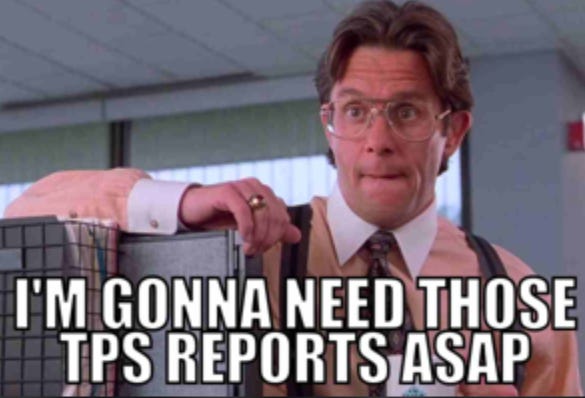
One time, I worked with a co-founder that had a military background. If corporate america likes TLAs, the military BFFs them. Every sentence practically had four of them. OMG I need that TPS report and ABC your ICP ASAP. 🤮
Why don’t I like these? They make it impossible for new people to integrate into your culture. Plus, you will inevitably start using this with customers and prospects and you spend half your time - “oh we call this feature AOP and over here this is our reporting piece we call RLE. Three hours later, ok, now we’re ready for the demo!”
Eliminate as many TLAs out of your org as possible, if you use them a lot, have an index/decoder/glossary in your communications so people don’t have to ask what it all means.
That’s a wrap!
We hope you’ve enjoyed this series. I’ve already heard from many founders who have used the frameworks in the board meeting section and quarterly update. Let us know what’s working and what’s not and we can workshop it together. If you have a killer best practice, keep those coming too!
Enjoying the content? Don’t forget to