


The Investor Relations, Communications Strategy Primer for NC Founders Series
Investor relations are critical. These investors and their LPs have invested their two most scarce resources: time and treasure into your company to support YOU the founder, in addition to building a great company, one of your top responsibilities is to keep them updated.
Who knows, down the road, you may hit a rough patch and need more capital. Also every existing investor is aligned in helping you solve problems, hiring and raise more capital. If you don’t keep them updated on the business, how are they supposed to do that? It seems like a lot of work, but over the years I’ve built a system that ‘waterfalls’ the information so you only build it once and then tweak it for each step of the waterfall.
The steps in the comms waterfall also are the article in the series:
IR Comms waterfall step 1: Quarterly Board meetings (Part 1 was here)
Optional: monthly Board update email - I call these FLASHs
IR Comms waterfall step 2: Quarterly Investor Updates (Part 2: You are HERE!)
IR Comms waterfall step 3: Team Update and All Hands meeting (Part 3: Coming next week)
We couldn’t share posts like this without our amazing sponsors:


Our Quarterly Update Philosophy
First, if all your investors are on your board, good news you can skip this because at this phase in your company, the Quarterly Update and the board meeting are one and the same.
However this is rare, so most of the founders out there are going to need to do quarterly updates.
As a fellow early-stage founder, here’s my mind space I get into as I draft the update:
The investors in early-stage startups have taken on both a lot of risk and a very long timeline- typically a 10yr expectation until some kind of liquidity event. If you think about quarterly updates over the next 10yrs you ‘owe’ them 40 updates.
A second part of that rule is - no surprises. I’ve learned over the decades doing this that it’s best to commit to aggressive transparency. If something goes wrong in the business (e.g. you lose your biggest customer, big M+A deal falls through, funding issue) , you should short-circuit all of this and get the bad news out ASAP. You don’t want to get 2-3yrs into the relationship with the investor and send an urgent:
That’s all, and if you follow our waterfall framework, all the work for the update has already been done for the board meeting package. What we’re doing is just distilling that information into a one page update - have an AI help you with it if you need, but always give it a personal touch.
9 Quarterly Update Best Practices
As we just announced with our Q3 2026 portfolio (here), at NC Tweener Fund with our ‘NC Tweener early-stage startup index fund strategy’ we have 189 portfolio and we read a LOT of updates. We collated through thee last years hundreds and hundreds of updates to come up with 9 best practices and 4 worst practices to help guide you in your quarterly report.
QUBP1: Send a !@#%!@ Quarterly Update
As mentioned, we have 189 portfolio companies and we only get quarterly updates from 65% of them. As a founder, that just blows my mind. Do we have formal information rights? Nope. Does this violate the terms of the agreement? Nope. Is this the right thing for the founder to do? Nope. If you follow the model we’re outlining in this series, the perfect quarterly update should take 1hr to make. That’s it out of a 520 hours in the quarter. You spend more time getting coffee.
Founders: Send those quarterly updates!!
QUBP2: KISS: Keep it Short and Simple
A perfect awesome quarterly update is short and sweet - 3mins, one page. Boom, that’s it.
Many of the best updates go longer which is great, but add a TL;DR. When we get to BP9, we’ll cover the top topics -put those in the TL;DR.
QUBP3: Format: Do what fits you best
Format doesn’t really matter. We get great updates from founders that send a one pager, some send a long form with TL;DR and some send a video. Some
What I personally do is a combo - I do a short-form written TL;DR that is, this will be a surprise, basically BP9 with my own fun twist. Then because I’m just set up for it due to the constant podcasting I do, I cut a < 30min video that goes through more detail. My thinking is to ‘meet the audience where they are’ - if they are on their phone and have time to ‘snack’ on the update- here’s the TL;DR. If they are more involved and want to really dig in, the video is where they can get into all the details behind the TL;DR - and hopefully if I’ve done my job, I’ve anticipated their questions and answered them.
Format-wise, I use Zoom to do a cloud recording with a password and send that. Some founders prefer Looma - those are all great formats.
QUBP4: Deliver the Payload🚀
This is a simple one - put your update in the email. That’s it. Don’t do an encrypted PDF, don’t make me login to Notion, don’t put it in Carta, don’t put it in your vibe-coded Claude artifact that requires me to be on the local network, etc.
Deliver the update. Investors know not to forward these or post them on X. Feel free to put ‘confidential do not forward’ as a reminder if that makes you feel better.
QUBP5: Timing
If you go back to our board meeting post, by day 14 - 2-3 business weeks from the end of the Q, you should have your Board deck ready and meeting in the rearview and that’s the best time to go ahead and send out your shareholder update.
I also like doing it after the board meeting because let’s say in the board meeting all of your directors have questions around one topic - that’s a signal that you blew the comms on that topic and the shareholder update is an opportunity to fix that.
That gives us this timing:
EOQ+14 - Board Meeting
EOQ+15 to 18 - Shareholder Update
QUBP6: Make an Ask, make it specific and easy
One thing in the mind of the investor is - we are super-aligned to be helpful. We want to make customer and investor intros. You should leverage the QUBP to have an ask, but make it specific.
Good: “We really need to speak to someone at SAS in their datacenter group, our LinkedIn research has found these 2 names - if you are connected, let me know and I’ll send you a forwardable intro.”
Bad: “We’re always looking for new customers -send us people that work with datacenters.”
QUBP7: Lay fundraising groundwork
Another aspect of my mindset: I may need to raise capital from this group of people again, when I project forward to that day, I want them to be:
Aware of all the tailwinds and headwinds in the business
Understand all the basics: ICP, business model, KPIs, KPI directions
ARR, upcoming fundraising events, etc.
When the time comes to raise a new round, a bridge, they should have known it’s coming for 6 months.
QUBP8: Answer Investor questions and feedback
Anecdotally when we receive updates at Tweener Fund, we’ll review them and then about 10% of the time we’ll have a quick question. Many times these will go unanswered.
An engaged investor is an investor that wants to help and potentially invest more - answer their questions. That’s it.
QUBP9: 9 ‘Must have’ Quarterly Update Topics
Here’s our recommended ‘must have’ topics to cover in your update. We’ve put them in preferred order (most to least) with a little commentary where it makes sense:
TL;DR - Only if over a page
KPIs - Make sure to include ARR and MRR and m/m, q/q, y/y changes to these Revenue, burn are important. In 2026, churn is a huge metric
Cash and runway - Every investor needs this for their internal planning. Pre-answer the question: “When could we potentially need to write a follow-on check into this investment?”
Fundraising status - If you are within 6mos of fundraising, this is a must have until closed.
Highlights
Lowlights
Goals - Look forward to the next Q, update on Yr if Q2/Q4.
Team - Any adds/churn/etc.
Asks - see QUBP6 for dets.
4 Quarterly Updates: What Not To Do!
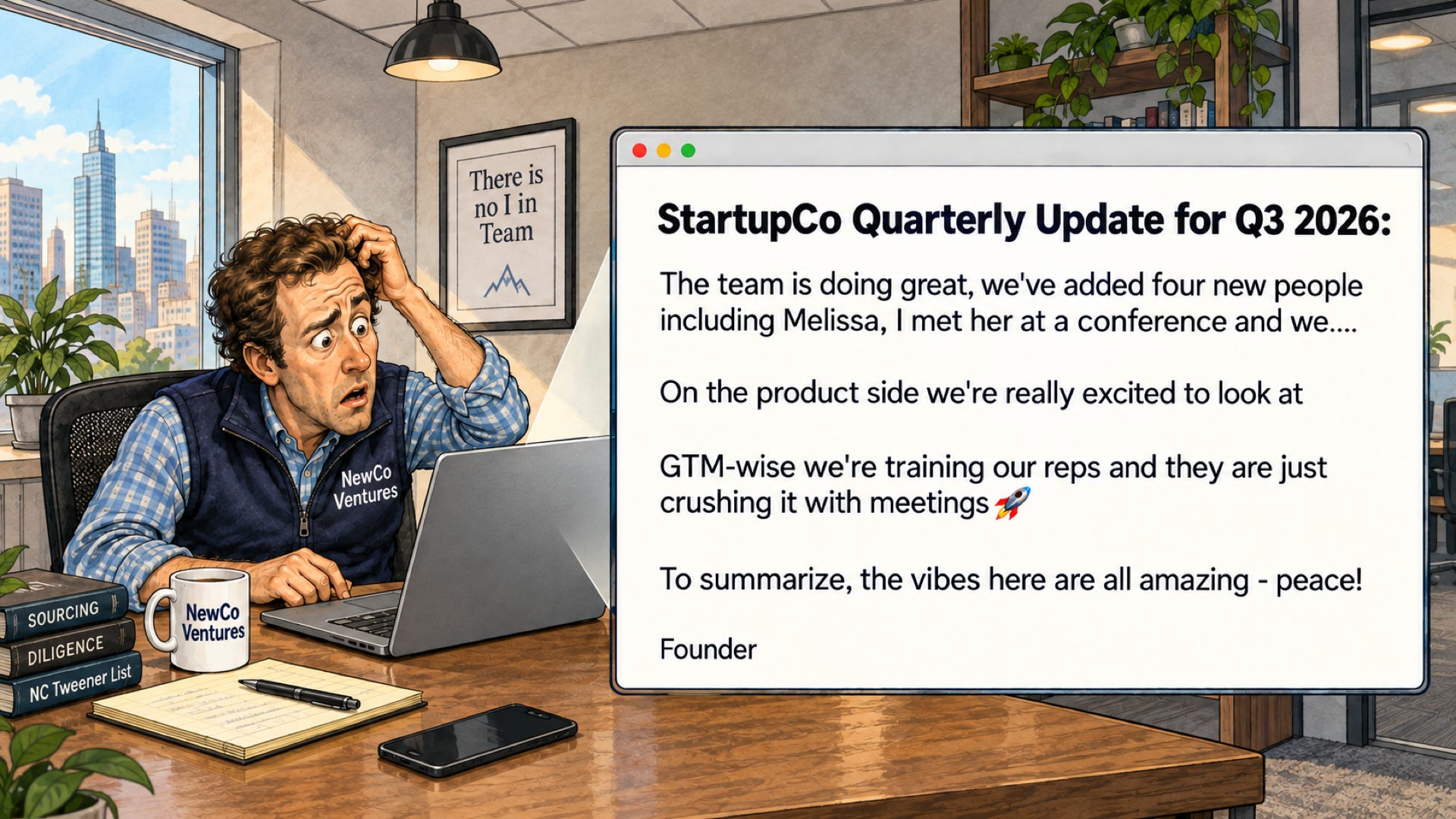
QUWNTD1: Focus on the Vibes
As depicted at the top of the article, we’ve noticed an increase in founders sending out updates that are long on ‘activities and excitement’ but short on KPIs, cash/runway status, customer closes, etc. If you don’t have those yet, that’s fine, just say it. Not saying it creates the impression in the investor’s mind that you are either not being transparent, maybe not focused on it, or not tracking it. None of those are good places for the investor’s mind to wander.
QUWNTD2: Bury the bad news
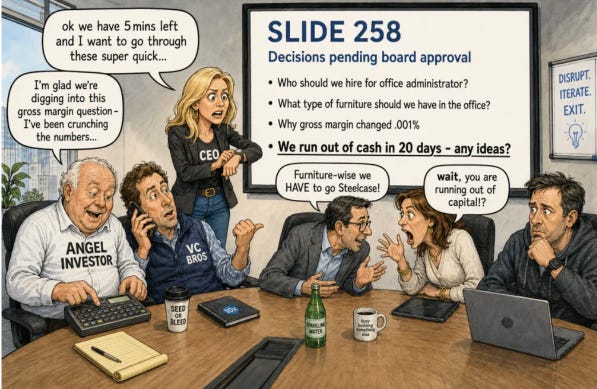
As depicted in this image from the board update piece, there is a very human “lead up to the bad news - tell the why and then bang the ‘what’ “ trap many founders fall into. We’ve seen the same thing in quarterly updates. 3 pages in and the last paragraph will be something like:
Personal update - I’ve decided to leave the startup and start a farm!
Burn update - We’re out of cash and have a meeting tomorrow to raise $500k bridge.
Customer update - As I was hitting send, we heard from our two biggest customers that represent 50% of revenue they are churning. Sit tight, I’m going to check into this and let you know next quarter what happened and what we’re doing - next update in March 2027, have a great holiday!
Those are exaggerations, but that’s how they land. First, all of that news should be delivered ASAP with a phone call. Second, please lead with the bad news - always get it out early and fast, it always is best.
QUWNTD3: Omit the big TWO metrics every investor cares about
Many of the updates we get are excellent but they omit any revenue, bookings, ARR/MRR growth type metrics. For our fund, tracking that is essential and I can assure you it is the one group of metrics everyone else needs in their internal tracking and funding decision process. The second is fundraising status.
QUWNTD4: NOT Sending Quarterly Updates
Just to harp on this, end out your updates founders!
Up Next
Next week we’ll wrap up the series by sharing some best (and worst!) practices on company/team updates and communications. Until then, remember to tell all your friends to…