


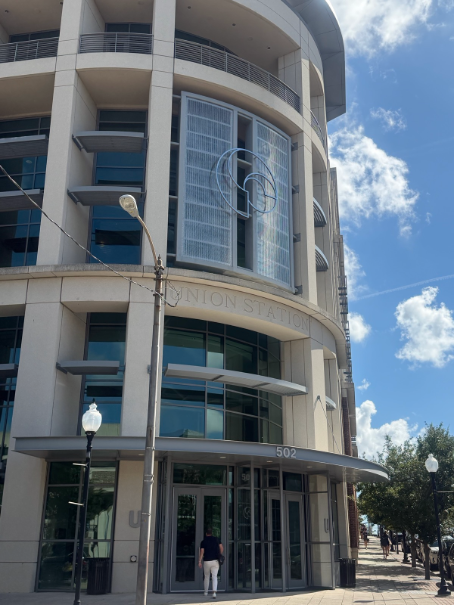
Cape Fear Community College’s Union Station, 502 N Front Street, Wilmington
In February, we partnered with NC IDEA to take the Tweener Fund statewide, and it became the NC Tweener Fund. We made that announcement in Wilmington, so it felt right to head back to the coast for the next stop on our road trip.
Scot kicked things off with a two-part report from ConvergeSouth in Winston-Salem (Part 1 and Part 2). Now it’s my turn. On Thursday, September 10, I was in Wilmington for the 4th annual Investor Buzz In, where I did a reverse pitch for the NC Tweener Fund and sat on a panel about AI.
Here’s a stat that might surprise Triangle folks: since January, the coast is second only to Charlotte among the regions outside the Triangle where the Tweener Fund has invested. There’s a lot going on down there, and the ‘Buzz In’ event is the best single day to see it.
Thanks to our sponsors for sponsoring this post:


About the Investor Buzz In
The Buzz In is put on by the Network for Entrepreneurs in Wilmington (NEW), led by our friend Jim Roberts. Buzz In bills itself as the only venture capital conference in North Carolina east of Raleigh. This year’s event was on 9/10, and since 910 is Wilmington’s area code, it doubled as “910 Day.” Get it?
The event has grown fast:
2023: The first Buzz In drew 53 investors representing more than $1B in capital.
2025: Nearly 300 attendees from 15 states.
2026: 322 people registered for 300 seats. Cape Fear Community College added 30 temporary chairs to fit everyone.
The day packed in a fireside chat, six panels, a round of reverse pitches from investors, and six founder pitches. The reverse pitch lineup alone had funds from Wilmington, the Triangle, Charlotte, New York, and California.
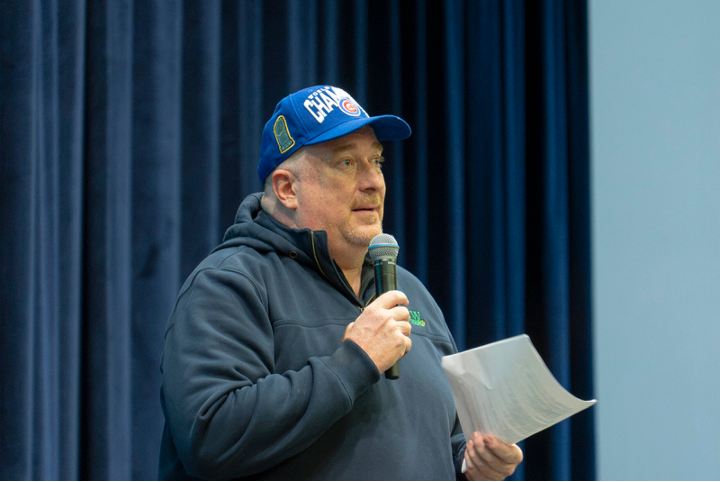
Jim Roberts, founder of the Network for Entrepreneurs in Wilmington
The Energy
The first thing you notice at the Buzz In is the energy. The room was packed, and people came to meet people.
A lot of that comes from Jim. He moved to Wilmington in 2013 to run UNCW’s Center for Innovation and Entrepreneurship (CIE), then went on to start NEW and the Wilmington Angels for Local Entrepreneurs (WALE). He is very good at putting on these events. He gets the right people in the room and keeps things moving. I spoke at one of Jim’s events last March, and it had the same feel. If you’ve never been to one, put it on your calendar.
Nice work to Jerry Coleman and Cape Fear Community College for hosting (and finding those extra chairs), and to the event sponsors, including Kymanox, Cape Fear Ventures, Canapi Ventures, and Launchpad from Greenville, SC.
Wilmington’s Startup Ecosystem
Our friend Tom Snyder at NC IDEA wrote a great overview of the coast for WRAL TechWire the week after the event. It’s worth a read. A few things that stood out:
The Live Oak family tree. Live Oak Bank was founded in Wilmington in 2005, and its fintech know-how produced nCino and Apiture. Those three companies have hired more than 1,000 UNCW graduates between them.
A unicorn. Vantaca, the property management software company, took a $300M+ minority growth investment at a $1.25B valuation in October 2025.
The community layer. NEW has more than 1,000 entrepreneurs in its network, and its monthly events average around 170 people. Heather McWhorter now runs the CIE, and Jack Fleming leads the weekly 1 Million Cups gathering.
Local capital. Cape Fear Ventures and VentureSouth are both active, along with WALE.
Tom was also clear about the gaps. Local investors say more capital needs to get activated. The CIE’s space is at capacity. There aren’t enough incubators, accelerators, or startup-focused service providers. And state and federal economic development still leans toward recruiting existing companies instead of growing new ones. His closing point was that Wilmington has to decide whether to treat entrepreneurship as infrastructure, the same way it treats roads, broadband, and airports. Several of the panels came back to those same themes.
Time to Learn!
Like ConvergeSouth, the best part of the day was the content. Here’s my recap of each session, in order, with our usual focus on what NC founders can take away.
Riverside Chat: Mike McGuire
Mike McGuire, former CEO of Grant Thornton, opened the day with a fireside chat (billed as a “Riverside Chat”) on culture and mindset.
Hiring is the culture decision. You can’t fix culture later if the first hires are wrong. Get the right people and the team becomes much more than the sum of its parts.
Curiosity scales. Founders have to be curious to change anything, and the job is to make that curiosity part of how the whole company works, not just the CEO.
Panel: Programming for Entrepreneurs That Has an IMPACT
Emil Runge of Launch Chapel Hill moderated this one. On stage: Taylor McLemore (Launchpad), Tom Snyder (NC IDEA), Hal Atkins (Companah), and Lydia Thomas (UNCW CIE). The question was what separates founder programs that work from ones that don’t.
Programs should build habits, not checklists. Entrepreneurship isn’t linear, and customer discovery isn’t something you finish. The best mentors get founders doing it every week.
Obsess over the problem. The founders who win are the ones who care more about the problem than their first solution.
Customers buy outcomes. Tom’s version: nobody wants your solution, they want what it does for them.
Reverse Pitches
Normally founders pitch investors. In a reverse pitch, investors pitch founders: who we are, what we invest in, and how to get on our radar. Seven of us went up:
Abby Phillips, Wolfpack Investor Network
Robbie Allen, NC Tweener Fund powered by NC IDEA
Paul Quadros, Band of Angels
Greg Brown, Charlotte Angel Fund
Mark Friedman, RTP Angel Fund
Virginie Raphael, Full Circle Fund
Richard Stroupe, Cape Fear Ventures
Virginie came down from New York (she was an early investor in Uber), and Paul came from California’s Band of Angels. Out-of-state investors making the trip to Wilmington says a lot about the deal flow at the coast.
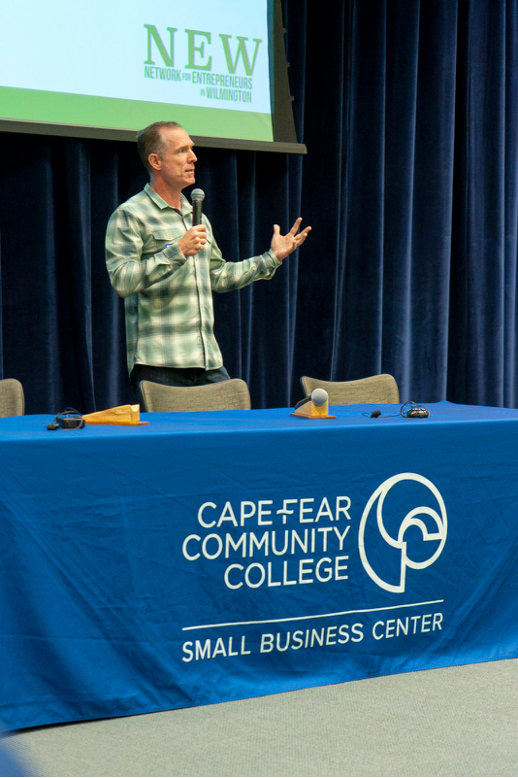
Pitching the NC Tweener Fund
I gave the standard Tweener pitch. If you haven’t heard it:
We take an index approach to venture. Instead of a few big bets, we write lots of smaller checks across the ecosystem so we don’t miss the winners.
We focus on Tweeners: companies with 10+ employees or $1M+ in revenue that have made it past the earliest, riskiest stage.
We’re active. PitchBook ranked us the most active investor in the Southeast in 2023 and 2024.
We’re statewide now. With NC IDEA as our cornerstone partner, we invest across all of North Carolina, not just the Triangle. That’s why I was in Wilmington.
If you’re building a company on the coast (or anywhere in NC) and we haven’t met, reach out through tweenerfund.com.
What about LPs?
For accredited investors that are interested in investing in NC startups, we are always open for new LPs. Tweener Fund is a ‘rolling fund’, meaning ‘always open’ and there is only a one year commitment of $30k ($7,500/Q) to get started. In that year you will build a highly diversified portfolio of 40+ early-stage NC tech companies. If you want to learn more check out the site and our AngelList landing page here.
Lunch Keynote Panel: Attracting More Local Investors
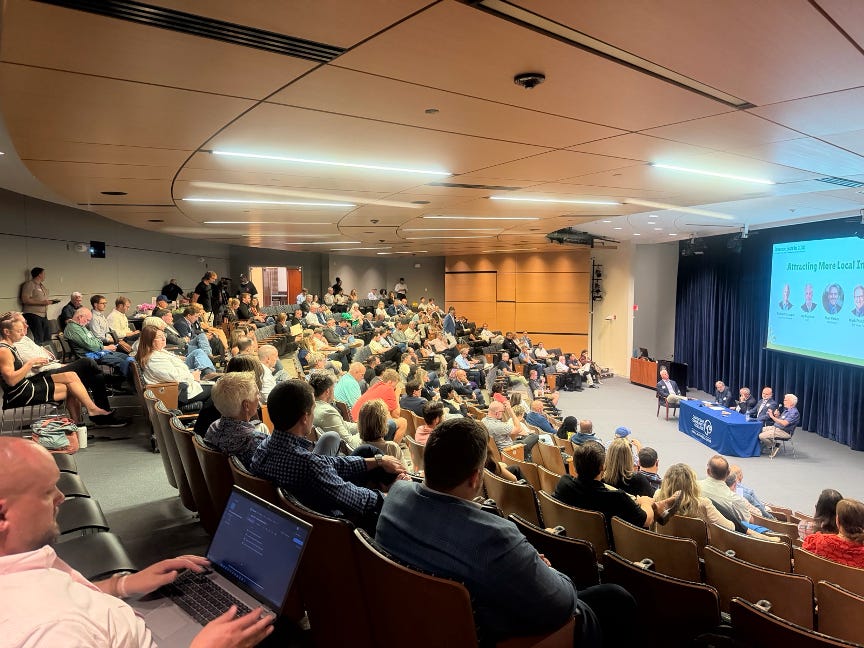
A full house for the lunch panel on attracting more local investors
This panel went straight at the capital gap. Richard Stroupe (Cape Fear Ventures) moderated, with Jay Bigelow (CED), Stan Parker (WSPR Fund), Mark Friedman (RTP Angel Fund), and Jeremy Turner (Appalachian Investors Alliance).
Jim shared a stat afterward that frames the problem: New Hanover County receives $1,359 per capita in philanthropic giving, compared to $7,633 in Buncombe and $19,635 in Forsyth, according to 2019 IRS data (The Assembly). Philanthropy isn’t angel investing, but it points the same direction.
Build the investor network first. Investors want to know each other. When they do, deals get shared, and founders get more introductions.
An ecosystem is something you do. Mark’s point was that the word only means something when people are actually doing the work.
Traction comes in more than one form. It isn’t always sales and revenue.
If WSPR sounds familiar, Scot wrote about the Winston-Salem Partners Roundtable in Part 1.
Panel: AI Impact on All Industries
This was my panel. Wade Minter (Suggestion Ox) moderated, and I was joined by Corbin Penland (Synply), Stephen Perry (Kymanox), and Christy Swann (RCOAST). We talked about how companies are actually putting AI to work and how to pitch it inside a company as an opportunity instead of a threat.
Start with contained use cases. Corbin’s approach is to prove value on narrow tasks where a person still reviews the output.
Talk about efficiency, not replacement. Christy framed AI as a way to get more out of every dollar by improving processes.
Adapt as it changes. Stephen’s advice was to keep moving with the technology instead of betting on where it is today. His version: move where the cheese is moving.
Panel: Life Sciences
Carson Jackson (NCInnovation) moderated a conversation with Dr. Morris Nguyen (Predicate), Paul Quadros (Band of Angels), and Brett Lanier (NCBiotech advisory board) about building life sciences companies in NC.
Founders need other founders. Morris credited the CIE for connecting Predicate to other founders early and helping them build good habits.
Support matters most early. Brett called the first stretch of building a company a trial by fire, and that’s when local programs like the CIE make the biggest difference.
Panel: Technology
Michelle Calton (NC TECH) moderated a mix of founders and investors: Tully Ryan (IQExit), Jenn Summe (Primordial Ventures), Robin Cowie (Skillmaker), and Matt Cimino (Amped Ventures).
Keep investors updated. Jenn said regular update emails are one of the clearest signs of a founder who follows through. As someone who reads a lot of these, I’ll second that one.
Get to revenue fast. Robin’s advice was to start selling as early as possible.
Small can be an advantage. Robin compared Wilmington to a tinderbox: with the right product, you can get in front of the right people very quickly.
You don’t have to move to Raleigh. Matt made the case that you can build a company from Wilmington, and pointed out that you can’t finish your day on a boat in Raleigh. Hard to argue with that.
Own a niche. Tully suggested Wilmington brand itself as a fintech hub, which makes sense given the Live Oak family tree.
Panel: The Future of the Wilmington Ecosystem
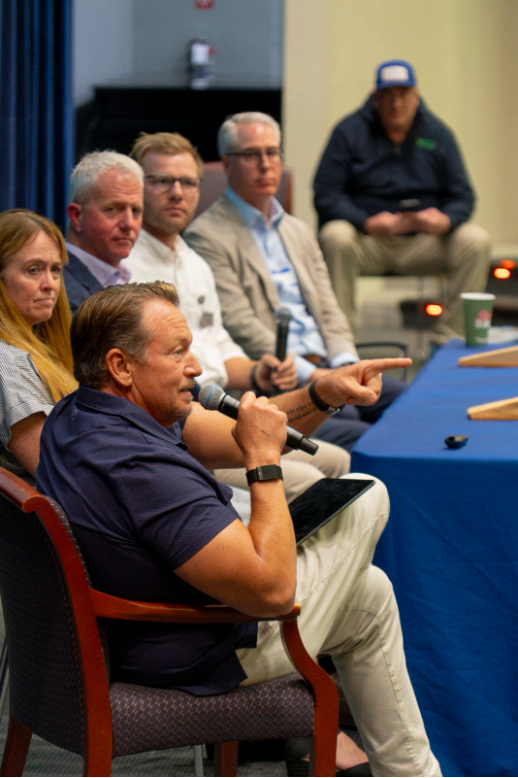
NC IDEA’s Thom Ruhe (front) moderating the closing panel
Thom Ruhe (NC IDEA) closed the day with Heather McWhorter (UNCW CIE), Richard Stroupe (Cape Fear Ventures), Scott Davis (NCInnovation’s Wilmington hub), and Dr. John Hardin (NC Department of Commerce Office of Science, Technology, and Innovation). This one picked up the same gaps Tom wrote about.
Visible champions help. Thom talked about how much momentum comes from well-known local leaders, like Richard, putting their time and money behind startups.
The university is an anchor. Heather described the CIE’s role in terms of jobs for graduates, research, and making Wilmington a place people want to live.
Elected officials are missing from the conversation. Both Scott and Heather raised it, which lines up with Tom’s point about government support.
NC has research assets to build on. John noted that North Carolina is unique in having three NSF-funded research initiatives.
Founder Pitches
Six founders pitched during the day, and five of them also sat on panels.
RCOAST (TWEENER FUND COMPANY): Dr. Christy Swann’s company uses drone-mounted LiDAR and machine learning to map coastal erosion, a multi-billion-dollar mitigation market. It has clients from North Carolina to Texas and announced a $945K pre-seed round at the event.
Skillmaker (TWEENER FUND COMPANY): Robin Cowie (whose resume includes The Blair Witch Project and the Madden franchise) is building AI-powered immersive training for auto repair technicians. Skillmaker has a national deal with NAPA and announced NAPA’s full autotech knowledge base is now on the platform. Jim introduced them as “the sexiest startup in North Carolina.”
Predicate: Dr. Morris Nguyen, a former physician, runs this Wilmington-based company that analyzes wearable data with AI to help clinicians catch sepsis and other conditions sooner. It runs trials across five continents and was named NC TECH’s Data Innovation Company of the Year.
Synply: Corbin Penland’s cloud platform for bank loan syndication. It was incubated inside Live Oak Bank and spun out in 2024, another branch on the Live Oak family tree.
IQExit: Tully Ryan’s company helps business owners understand how ready they are for an exit, and on what timeline, using bank assessment and banking relationship data.
Nuream: Sleepwear with built-in sensors that capture brain and heart signals, aimed at better sleep and earlier detection of conditions like Alzheimer’s, MS, and depression.
Congrats to Christy and the RCOAST team on closing the round. Pitching and panel duty on the same day is a lot.
That’s a Wrap! What’s Next?
If the Buzz In made you want to spend more time at the coast, Jim shared what’s coming up:
Sept 29: UNCW CIE Ocean Innovation Conference
October: Cape Fear ELEVATE CEO Retreat, hosted by Richard Stroupe
Nov 12-13: NC IDEA Ecosystem Summit, in Wilmington
Nov 16: NC TECH Annual Awards, in the Triangle
If you’re building something near Wilmington and we haven’t met yet, reach out.