


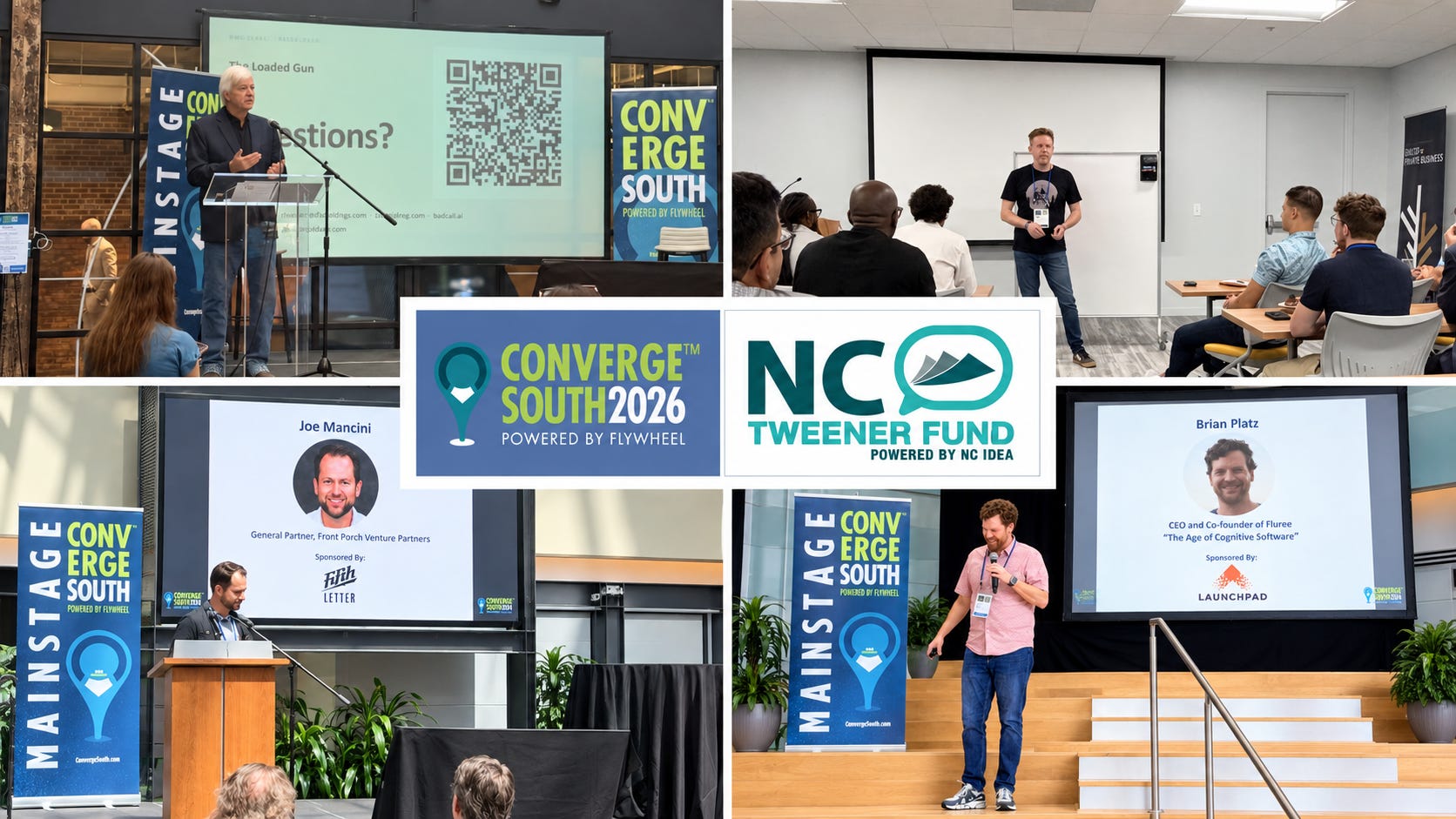
Welcome to part 2 of our 2-part Converge South Trip report:
In part 1 we went through the conference’s history, the Winston Salem innovation district and the three primary locations that held the Converge South 2026 and are ‘anchors’ for the Winston Salem startup ecosystem. You can read it here.
Here in part 2, we’re going to recap 4 of the keynotes we attended that all had great lessons for NC founders and recap the pitch event.
Time to Learn!
It’s always great to learn about a new ecosystem, see their facilities and see old friends, but the best part of a trip like this is learning new things and hanging out with founders and ConvergeSouth delivered on that!
In this post we go through 4 of the awesome keynotes and then talk about some of many other founders we met at the pitch events. Let’s kick it off with our buddy Joe Mancini’s keynote. But before then, check out sponsors→
Featured Platinum Sponsor

Featured Gold Sponsor

Featured Silver Sponsor

Joe Mancini Keynote
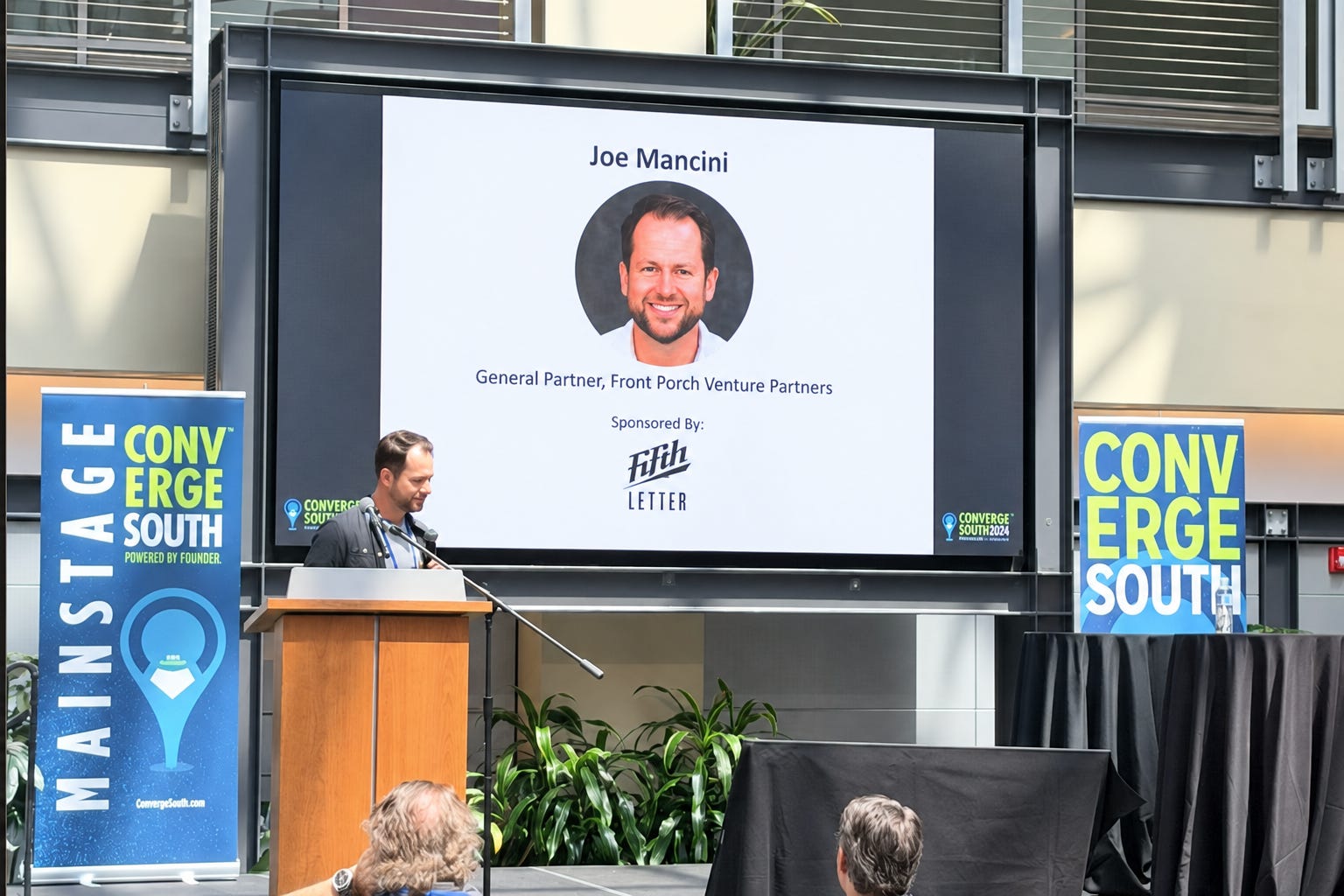
I’m going to start with the last first. Joe Mancini is a friend of NC Tweener (check out his appearance on our podcast here, where we talked about the SaaSageddon). Joe wrapped the conference with a talk titled: “The Next Great Startup Ecosystem”.
Front Porch’s approach to be a ‘fund of fund’ where they invest in venture funds throughout the south-east gives them an unprecented view of what’s going on across the entire south east region. They do an annual survey of their funds mixed with empirical research and generated these datapoints highlighting the positives for our larger region that includes NC:
Southeast macro indicators are “flashing green”: population inflow, GDP growth, wealth migration, risk capital, cost advantages, and anchor corporates.
About $100B of wealth has moved South in recent years, alongside millions of new residents.
Atlanta produced 20 unicorns over the last 15 years.
The region has 23 startup hubs, generally about two hours apart, which may accelerate ecosystem development relative to a typical 10–20 year hub-building cycle.
Front Porch compared the Southeast in 2026 to Seattle in 1995 or Austin in 2005, while emphasizing the Southeast’s interconnected regional network.
Founder trees and recycled liquidity are expanding across hubs; Atlanta’s David Cummings was cited as an example of an entrepreneur, investor, LP, and incubator builder.
Regional specialization is forming: supply chain/logistics in Atlanta, health and health-tech in Nashville, and cybersecurity in Tampa.
In Front Porch’s survey of 50 GPs and principals, the VC confidence index was slightly higher year over year; the startup outlook was the most bullish measure, while fund fundraising was the most bearish.
Survey respondents reported that investment activity was not frozen: new investments, fundraises/evaluation of next funds, and exits increased.
The early-stage market has reset into two paths: earlier pre-seed investing with lighter checks, and later seed investing around roughly $1M ARR with higher prices.
Talent retention was presented as a Southeast advantage: one example contrasted roughly three-year retention locally with around nine months in the Bay Area.
If you want to learn more or see the backup data behind all this, the deck is attached→

Nathan Powell Keynote
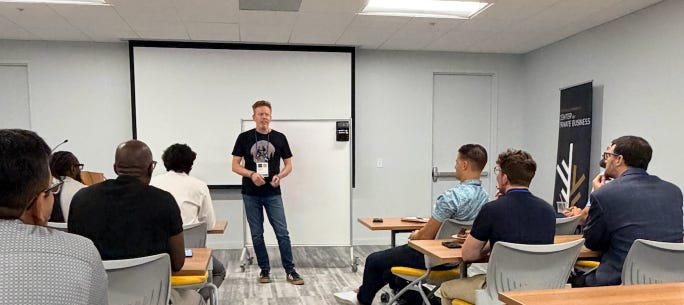
Nathan Powell delivered a great keynote titled: “What’s Wrong with Building a Company Warren Buffett Would Buy?”
Nathan’s Bio
Nathan co-founded Threat Sketch, a cybersecurity startup born out of Winston Salem’s Flywheel community, and now helps companies put AI to work at ArcCrest Advisors. His local startup roots go back to 2015, when he met his Threat Sketch co-founder while volunteering at Startup Grind. He’s also helped other founders get going as a mentor in Flywheel’s startup programs. (Innovation Quarter, ArcCrest, Center for Creative Economy)
Nathan’s Key Points for Founders:
Build for sustainability, not unicorn status. A $5-10M, cash-flow-positive company can create jobs, provide benefits, and compound for decades.
Singles count. Founders don’t need to swing for a billion-dollar exit; consistently building valuable niche businesses is a viable strategy. Is it better to focus on a home run or a portfolio of singles/doubles and triples? Moneyball it!
Customer discovery beats an early MVP. One standout founder had 70 pages of customer research before building anything - and later secured customers including NBC and Amazon.
Observe customers in their real environment. Watching pharmacists work exposed critical UX realities - standing desks, keyboard-heavy workflows, multiple monitors - that interviews and prototypes missed.
Design around the customer’s constraints. If your workflow takes an hour but customers only have 15 minutes, the product needs to change - not the customer.
Beware courtesy bias. Customers may tell you what you want to hear; watching them use the product often produces better insight than asking whether they like it.
Use AI to analyze discovery, not replace it. AI can organize research and generate hypotheses, but founders still need direct customer conversations and observation.
The strongest AI moats are proprietary data and operational lock-in. Product development is getting easier, so defensibility increasingly comes from unique data and becoming embedded in customer workflows. (I’m going to plus 💯) this one! Want to learn more about competitive moats, check out my RDSW talk here.
I enjoyed Nathan’s laid-back approach to speaking, practicality and willingness to share these insights - great founder, see him you can when you go to Winston Salem.
Brian Platz Keynote
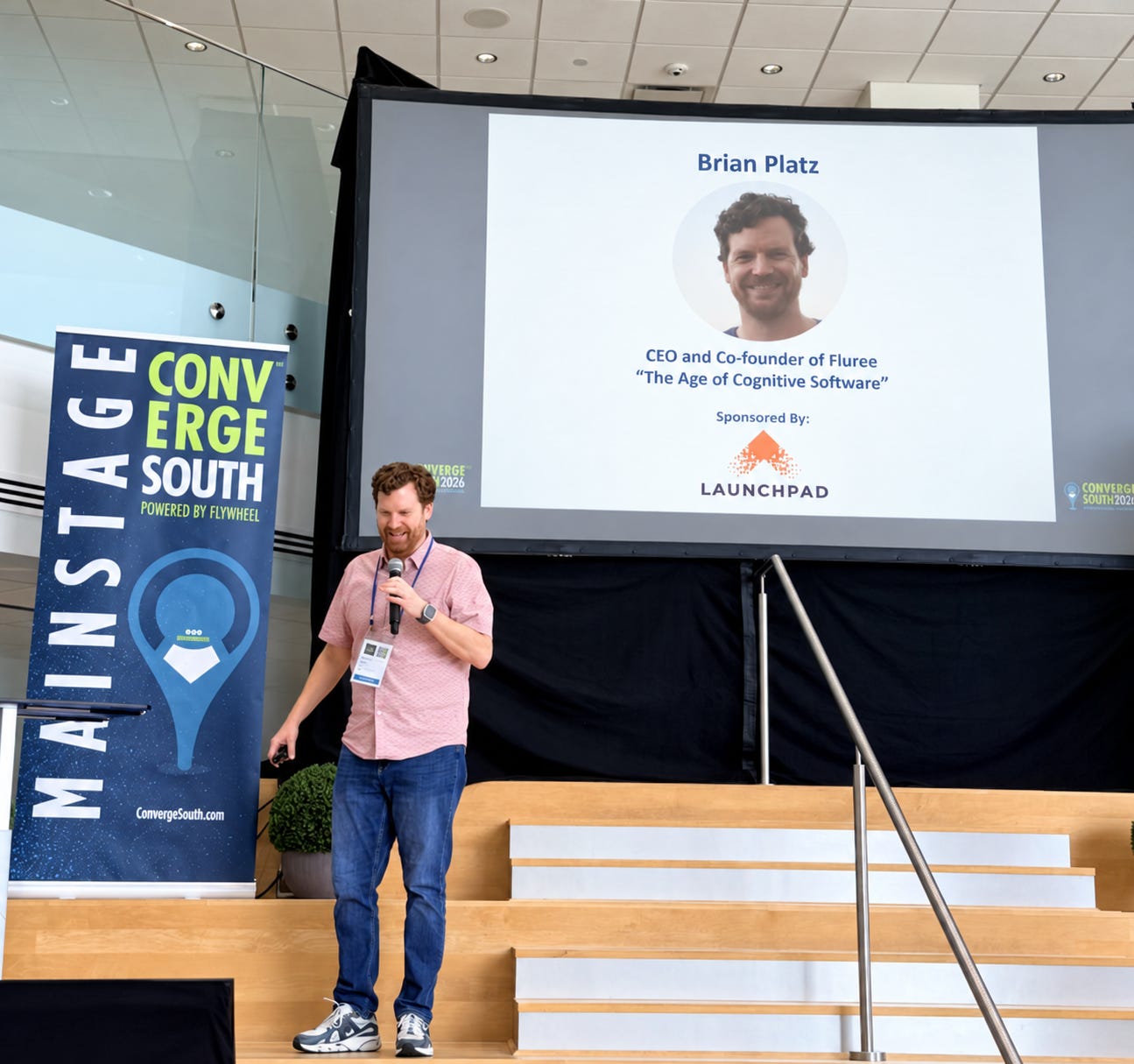
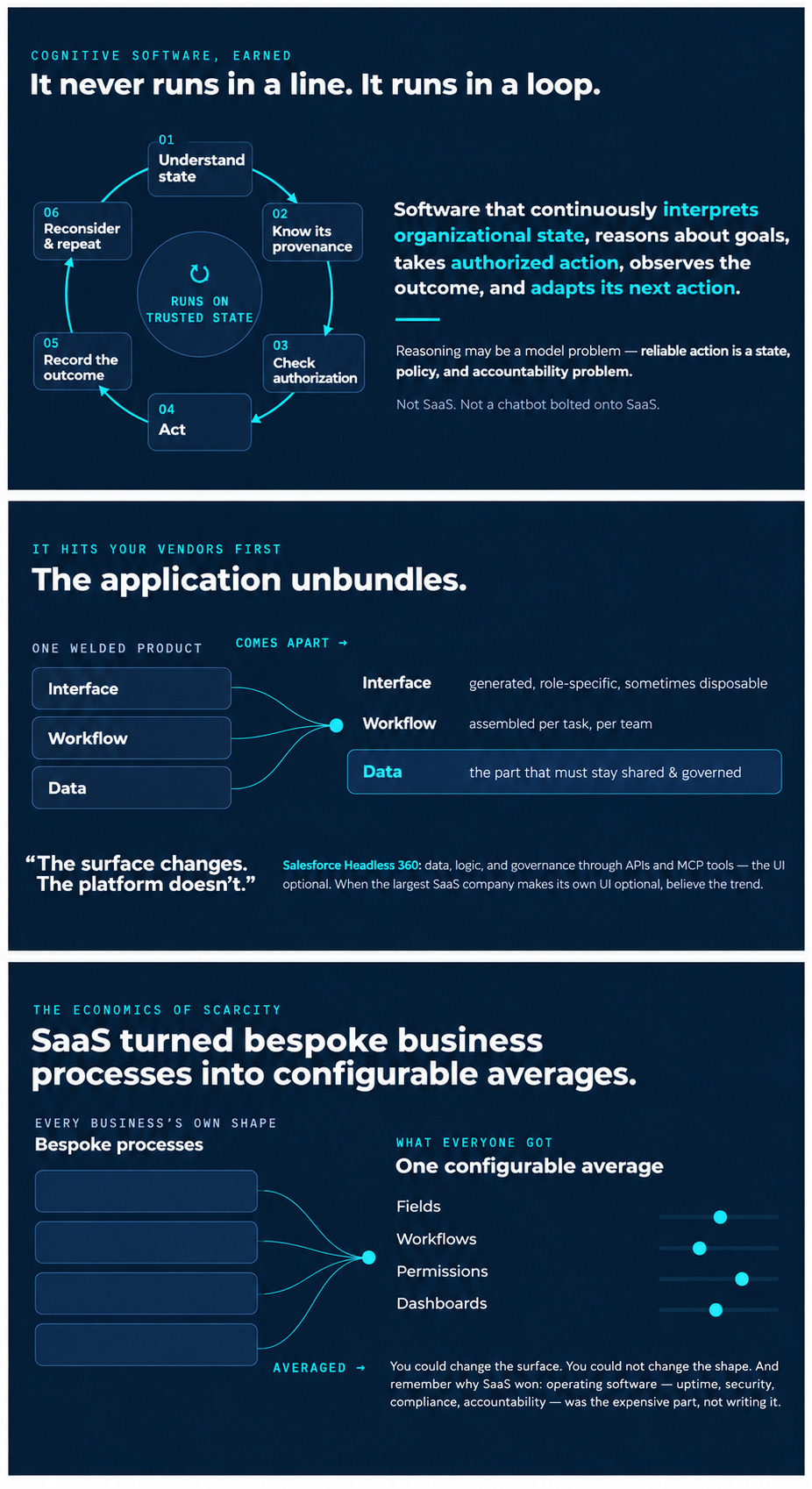
Next up, Brian Platz gave a talk: “The Age of Cognitive Software”.
Brian’s Bio
Brian is a repeat founder with some serious scale under his belt: he co-founded SilkRoad Technology, which grew to 2,000+ customers and 500 employees across 12 global offices. He then co-founded Fluree in Winston Salem, building a data platform for trusted, connected information. He’s also sharing those company-building lessons with the local startup community through Winston Starts’ Founders Forum and ConvergeSouth. (Flywheel, Greater Winston-Salem, Winston Starts)
Brian’s Key Points for Founders: from “The Age of Cognitive Software”
Assume code will become cheap and easy to replicate. Build your moat around what competitors cannot quickly copy. Moats!!
Judgment matters more than output. Knowing what to build and how to deliver business results will outweigh the ability to ship code.
Own the trusted data layer in your market. AI cannot reliably make decisions without governed, authoritative data.
Earn the right to act inside customers’ organizations through trust, expertise, security, and proven outcomes.
Expect SaaS to shift from standardized products toward customized, AI-generated interfaces built on shared data and workflows.
Prepare for seat-based pricing to weaken. Explore capacity, performance, and outcome-based models.
Sell measurable value, not software features. Proving savings or revenue impact before closing can become a powerful sales motion.
Distribution and customer relationships remain durable advantages, even as proprietary code becomes less defensible.
As an AI-era founder, I found Brian talk to be spot-on for the moment we’re living in right now. Even though it’s a scary time, Brian was able to boil it down into positive, forward-moving strategies. Fluree has raised $25m and ‘one to watch’ in the NC startup ecosystem, and Brian seems like a great leader
Elliott Strunk Keynote
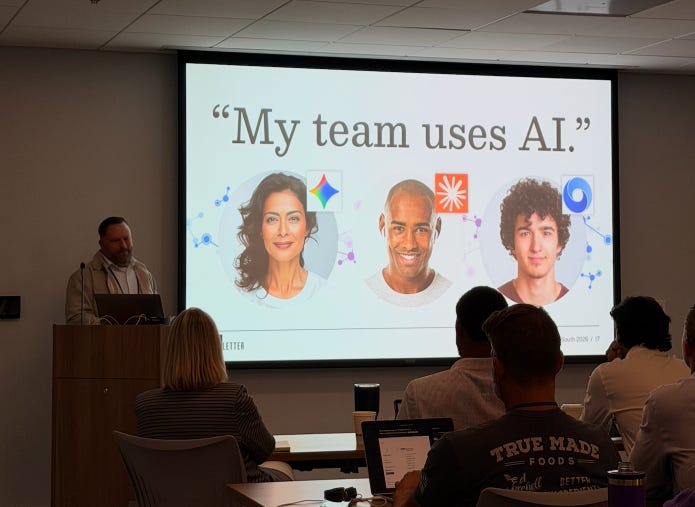
Next up, Elliott Strunk delivered a keynote: “Beyond the Prompt: Building AI Into Marketing Operations; From Experimentation to Execution”
Elliott Strunk’s Bio
Elliot founded Fifth Letter in Winston Salem in 2005 and has spent more than 20 years building a creative business that helps companies figure out their brand and tell their story. His work spans new business launches, technology, food and beverage, and plenty more. He’s also helped build the region’s creative community, co-founding AIGA Triad NC and creating internships and networking opportunities for the next generation of designers. (Graphic Design USA)
Founder Lesson’s from Elliott’s Talk
An AI advantage comes from building repeatable systems, not just writing better prompts.
Treat ad hoc AI use as an operational risk. If workflows live in one employee’s tools, prompts, and personal accounts, knowledge disappears when they leave.
Start with one high-friction marketing process and improve it this week. Define the outcome, workflow, review step, and how you will iterate.
Keep humans in the loop. AI output still needs review for brand fit, editorial voice, accuracy, and usefulness.
Package the solution, not the underlying complexity. Fifth Letter found that embedding its ethical AI framework inside tools worked better than selling the framework alone.
Founder-built software does not need to serve millions. A focused tool for 100 to 1,000 customers can create durable, useful recurring revenue.
Elliott’s firm, Fifth Letter, has created an ethical/safe (doesn’t train on your data) system called Echo→

That is available for free here: https://www.startwithecho.com/
Rick Leander Keynote
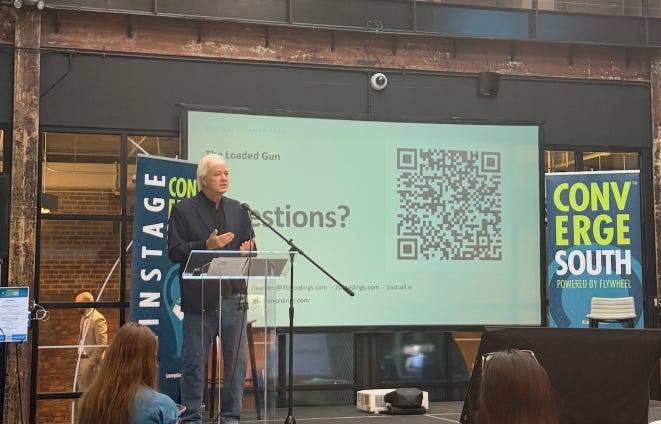
For the last keynote we wanted to spotlight, Rick Leander gave the provactively named talk: “Loaded Gun, Your Worst Decision This Year Will Feel Like Your Best Meeting”
Rick’s Bio
Rick founded LFB Holdings and brings decades of experience building and running businesses across banking, technology and fintech. Today, he helps founders and investors make better decisions about risk, capital and growth. In Winston Salem, he puts that experience to work as a Winston Starts mentor and a Flywheel Foundation board member, helping the next wave of entrepreneurs build their companies. (LFB Holdings, Winston Starts, Flywheel Foundation)
Highlights from Rick’s talk
Rick’s talk was all about how to make smarter decisions and he had a lot of research to back it up. The highlights:
Independent judgments create hidden “noise,” even when teams review the same information.
Founders should speak last so their opinions do not anchor the team’s thinking.
Collect written opinions before discussion to preserve independent perspectives and expose meaningful differences.
Before making a decision, define the evidence that would cause you to reverse course and schedule a review date.
Fight complexity by explicitly deciding what to stop. Consider a one-in, one-out rule for priorities and features.
In addition to the keynotes, we were invited to judge three rounds of the startup pitch contest, here’s what that was like.
Pitch Contest
ConvergeSouth hosted a regional qualifier for the Startup World Cup, giving founders a shot at advancing to San Francisco to compete for a $1M investment from Pegasus Tech Ventures. The competition spanned the event’s healthcare/biotech, AI/B2B SaaS, and food/beverage/agtech tracks.
Pitches We Saw
Arclite: Cash flow intelligence platform for SMBs that integrates with QuickBooks, Plaid, Stripe, and HubSpot to forecast cash, automate collections, and schedule payables.
BattleBox AI: Military edge AI translation device for real-time, secure multilingual radio communication in offline environments.
Career Maven Consulting: Tech-enabled outplacement platform for mid-market employers, offering an eight-week job transition program and optional coaching; it referenced an MVP test with a nonprofit in Macon County.
CashMap: Community investment intelligence platform that helps banks, foundations, and nonprofits verify and analyze impact data; it plans to launch pilots and expand across North Carolina.
CFO Link: Traceable 13-week cash flow forecasting platform for founder-led service companies, combining accounting data with CRM and spreadsheet inputs.
Clara: A wedding operations platform that keeps planners, vendors, and couples synchronized through live timelines, budgets, seating charts, contracts, and other coordination tools; from Alabama
ConsultFlow: An AI workflow platform that drafts expert consultation outputs and learns from expert edits, initially focused on veterinary oncology at NC State Veterinary Hospital.
FocusAI: A governed AI operations platform that helps regulated organizations and AI service providers manage AI workflows, controls, observability, and ROI.
Hardshell: A data-centric AI security platform that hardens sensitive enterprise data for use in AI systems without moving it outside the customer environment.
Iguana Cyber: A cybersecurity platform that uses divergent responses across two backend systems to detect and automatically block novel attacks. If this sounds familiar, they were in Tweener Madness.
Inspire Genius: A behavioral science and AI coaching platform that provides personalized career, workforce-transition, and life guidance using Prism Brain Mapping.
InstaRails: Cross-border payments platform that connects directly to destination-country banks to deliver faster, lower-cost international payments. Based in Atlanta, Georgia.
LinkSync: Multi-party scheduling tool that lets participants connect calendars and automatically find a meeting time across organizations and calendar platforms.
LiveSense: Builds vehicle-mounted, edge-AI sensors that collect real-time infrastructure and environmental data for transit agencies and other data buyers. Based in Toronto, Canada.
Magentix: AI visibility platform that helps businesses improve how they are found and recommended by systems like ChatGPT, Perplexity, and Google AI Overviews.
Monty: AI CFO platform for SMBs that normalizes accounting data into financial statements, metrics, and decision-support tools.
Minerva Lithium / Genesis X: Battery-supply-chain technology that uses non-destructive scanning and AI to identify battery chemistry and sort recycling feedstock. Based in Greensboro.
Congrats to Chonex!
Spoiler alert: Chonex won the contest and will be the ConvergeSouth entry into the $1m context in SFO. Sadly they weren’t in our pitch cohort, so we didn’t see them live, but what they do:
About Chonex - the ConvergeSouth Pitch Champ 🏆
The Alabama startup’s StrongSoil product turns agricultural byproducts into biological inputs designed to improve soil health and help farmers get more from their fertilizer dollars. (CHONEX) Michael Pisciotta delivered the winning pitch, and CEO Michael Lynch shared the news on LinkedIn: next stop, the global competition in November. Pretty cool to see an agtech company earn its way onto a global stage through Winston Salem!
That’s a Wrap! What’s Next?!
This concludes the end of our Winston Salem/Converge South trip report. Up next we’re bouncing from the NC Triad to the NC Coast! Robbie attended the 4th annual Wilmington ‘Buzz in’ event for investors which was also held in concert with their #910 (on 9/10 and that’s their zip code) day - get it?
The event was held by our friends at Network for entrepreneurs in Wilmington, led by our other friend Jim Roberts.
Robbie’s going to give us an insider’s recap of the buzz-in with our usual focus on founder-oriented takeways from the event(s).