
The Tweener Founder Bat Phone is Ringing Off the Hook: SaaS Blood is in the Water - What Should Triangle Founders Do?
We interrupt our normal programming to address the collapse in SaaS valuations and the threat of AI.
Editorial note: We’re half-way through a 4 part series on founder optimization: (Personal Productivity, Health Optimization, GTMStack Optimization and DevStack Optimization) and are pausing this week to address what’s on everyone’s minds. We’ll pick it back up next week with the GTMStack post, thanks for your patience).
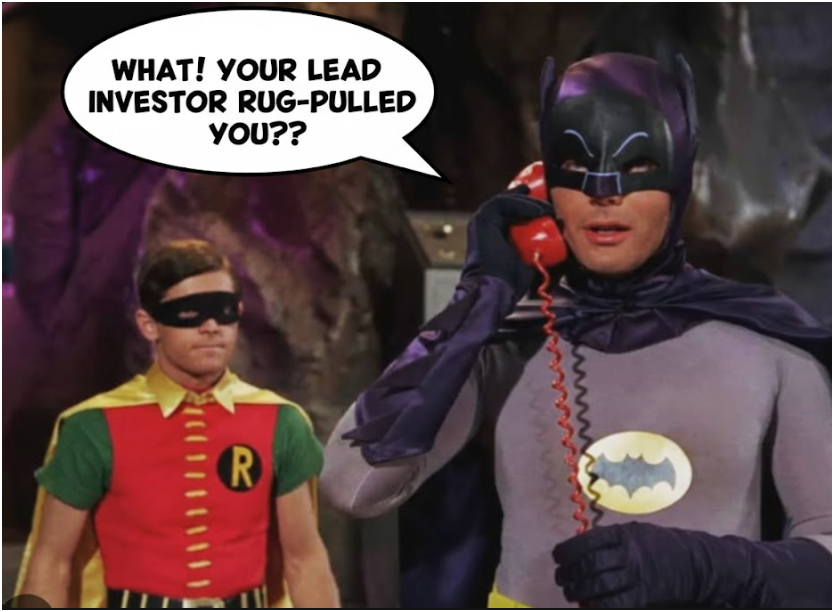
One of our value-adds here at Tweener Fund for the founders of the ~165 companies we have invested in is that if something comes up and they need an experienced local founder to talk about it - Robbie and I are available to help them. I call it the bat phone which is a reference to the awesomely cheesy late 60’s Adam West Batman series. Here’s the other side of the Bat phone line→
It’s so amazing it has to be kept under the fancy glass!
Over the last two weeks, the Tweener Bat Phone has been ringing with concerns:
Investors and M+A totally rug-pulling at the last minute - Basically leaving the startup at the proverbial altar.
Investors and M+A re-trading deals - Instead of bailing, at the last minute they will say: “Hey I know we were talking about a valuation of $15m, but given the market conditions, we think $8m is better today.”
It’s hard to decide which of these is worse as they both are terrible situations to navigate as a founder, but they are definitely spiking right now.
We’ll get to the ‘what to do’ in a minute, but for now, let’s make sure we’re all on the same page about what’s causing this very odd behavior and the current bear mood in the overall SaaS sector.
Before we jump in, a word from our sponsors:
Featured Gold Sponsor
Featured Silver Sponsor
🦈SAAS Blood in the Water 🦈
Several events have caused the ‘animal spirits’ of Wall St. to really stir, creating two ‘walls of worry’ that together don’t make much sense, but here’s all the worries in the mix.
Wall of Worry One: AI is getting so good, you won’t need software
Here’s how we got here:
Jan 12 - Anthropic released a knowledge worker version of Claude Code, called Claude Cowork. Nothing happened
Jan 30 - Somewhat normally Anthropic announced some skills for Cowork: legal, finance, sales and marketing, etc.
For reasons we’ll probably never understand, those seemingly innocuous Claude Cowork skills hit a nerve with Wall St. Sellers took down every SaaS companies in each of the categories 10% plus and it hasn’t stopped since. Legalzoom, Thompson Reuters, Intuit, PayPal, Equifax, so on and so-forth.
Wall of Worry Two: The Mag7 is spending too much on AI CapEx
Starting with META on Jan 28, each company that has large datacenters: Google, Amazon, Microsoft and META, announced their Q4 2025 results. At the end of the fiscal year it’s customary to provide the forward year’s guidance (2026 in this example). Wall St. knew this would go up, but they never expected it to DOUBLE and…yep…it did→
Now, along with this, each company showed the ‘backlog’ or revenue they would have made if they weren’t supply-constrained from the demand that was through the roof. In most cases, except META because their internal biz is their backlog, it was higher than the CAPEX spend, which is just insane. Wall St glossed over the demand (or maybe they didn’t) and sent the Mag7 to the woodshed too!
The Result: Bears Gone Wild!
These walls of worry crashed together so that both SaaS companies and AI companies running for the exits. Doesn’t make sense does it? That’s animal spirits. They tend not to make sense in the short run, but over a longer time horizon, it evens out.
This brings us to the logical question:
What’s This Have to do with Me? (A Private Company Founder in the Triangle)
Here’s where it all comes together. Private and public markets are closely linked. Private company investors derive their thoughts on valuations for early-state and growth-stage companies based on public comps. Not because they expect every company to go public, but they DO expect every exit to be either an IPO or an M+A, likely by…a public company. When public companies do M+A, their valuation math is anchored on public company comps.
The result: public company comps ‘roll downhill’ into private company comps. If you’re reading this and you’re not a SaaS company - let’s say a deeptech or consumer or whatever. Unfortunately, your comps are most likely, in the VCs mind, anchored off of SaaS comps. For example, many investors will say: a business without recurring revenue or some portion isn’t recurring will be a 3-4x discount from the SaaS equivalent and so on. SaaS has become so popular, the SaaS comps drive 95%+ of the private company economic math. When valuations were going up, this was awesome, but in these downdrafts like this, COVID, the 2008 financial crisis, it hurts the whole ecosystem.
The Triangle Ecosystem’s Silver Lining…
One fortunate thing about being in the Triangle at these times that hurts us in the boom times is that, with some exceptions, our companies are not getting the Silicon Valley nose-bleed valuations. Those ‘vanity valuations’ are exciting and headline grabbing on the way up. On the way down, they can be a death sentence.
Here’s an example that a prototypical: Founders have a great idea in Silicon Valley and it’s a crazy up cycle. They are 2nd-time founders, and their Devtech round starts getting frenzied. They have 20k mrr, so very early, probably not through PMF, but they start getting termsheets for a seed and end up taking $15m on a $50m pre - for a $65m post. This is an amazing valuation and in the snap of the fingers on paper the founders are worth $40m or so after dilution. Let’s say there are two founders and they just went from a net worth in this company of effectively $0 to $20m each. Plus their business has $15m and they can go 25 years at their current $20k burn rate. SaaS multiples at this moment are 20X for fast growers so they have 25 years (well really 3) to get to that $65m valuation which would mean they need to get to $4m to get there and to have a nice up round call it $8m. Spend $15 to get $8 and a long time horizon - easy peasy.
They start plugging away at it and since they have so much cash, they might as well turn up the burn a bit - hire some people they’ll need anyway - 4 more devs and 4 sales and need marketing so 4 of those. Now we need space and all the co’s in our devtech world are in the dogpatch in SFO so we get a nice space there - if we go for 8k space that gives us a lot of room to grow and while that’s $48k/m - that brings our runway down to 12yrs - haha, we’ll be ok. If we sign a 10yr lease we get to really trick it out and make it nice with a coffee station and part-time barista.
They wake up 2 years later and have 6 months of cash left and $1.5m ARR. They go to investors to get more. And in those 2 years the valuation comps reset down to 10x. They convince investors to look at next year’s forecast of $2.5m, and they see $25m vs $65m hurdle and decide they would rather not invest more on that math. Now the company is stuck. The only variable expense they have is people, so they shed people, they try subletting out 90% of the space, but the dogpatch is out of favor and SOMA is in, etc. This bust cycle takes out 50-70% of that crop of companies.
Boom/bust/boom/bust and so it goes.
Here in the Triangle we do have these cycles but they are muted, so the bust cycle clears out 5% of the companies. We’re also more diverse company-wise. We have tons of Healthtech which is less immune to these cycles and ‘boring industries’ like AgTech help dampen the Bay area like oscillations.
Ok, Now What Do I Do?
Just because we’re more immune from the bust cycle doesn’t mean we both feel it and prudent founders are worried about the future. Let’s apply first-principles thinking and look more closely at the comps. If you read our ‘What we read this week’ post we frequently reference the work of Jamin Ball. He’s with Altimeter and in his weekly “Clouded Judgement” article (which is a must-read for any SaaS founder for sure, most others should scan it), he has provided (for as long as I can recall) a very consistent SaaS multiple analysis.
In fact, in this week’s ‘All in podcast’ Brad Gerstner, from Altimeter, was on specifically to answer the question: “Why Are Stocks Tanking” and I knew exactly what he was going to say, because days earlier I had seen the charts from Clouded Judgement. It’s that predictive.
Here are the three charts that show us what’s going on with more clarity→
Conclusion: This is the lowest Public SaaS multiples have gone (3.5x) since 2014
Some people disagree you should look at revenue multiples and look at FCF instead, this argument would be true if the market is down on EV because of concerns around profitability, so let’s check that:
Same story 23x FCF is the lowest by a big margin. The other factor could be performance-based - what if the economy is really slowing, that would cause multiples to come down because growth is coming down. Let’s check that→
Nope, next-twelve-month growth forecasts are steady (right axis) at 11.5% and right there smack in the middle of historicals. The correlation between growth and multiple has clearly been broken if you look at this chart.
We’re left with one conclusion given the timing of this (Anthropic Cowork Skills on 1/30) and the other evidence: The market is worried that AI will eat software. Said another way, what if every SaaS software will get vibe coded away?
Triangle Founder Action Plan
In times like this, the worst thing you can do is analysis paralysis or ‘wait to see if it impacts you’. The time for action is now, and here’s a Three Phase action plan:
Phase I: Batten Down the Hatches
Here’s the Phase I steps:
Your job as CEO is to make sure your company is around through this. That means runway, that means cash, that means reduce burn.
If you have any fundraising in motion right now or M+A - go faster. Tell your lawyers, tell your team, this is now the tippy top priority and you want to pull in the timeframe as much as possible. GET THE DEAL DONE AS FAST AS POSSIBLE.
If your runway isn’t at least 18 months and ideally 24 months, fixing this is your top priority. Two prongs of action:
Raise capital from existing investors now - it will be a race to tap into reserves, get a bridge going - propose a SAFE, don’t get hung up on terms
Reduce burn - We’re early into this, maybe for the next 2 weeks freeze hiring and then if things get worse, have a plan for what that looks like.
Phase II: Analyze and Cover your AI Risk
Remember, over the long run, the market will sort through this. There will be some companies that do get vibe coded away, the ones that don’t, that make it through will get back to normal. How will the market figure this out?
I predict we’re about to enter a phase of hyper never-before-seen focus on churn data and NRR/GRR metrics. Existing and future investors are going to do forensic dives into this data, because this is the data that will tell the story of vibe coding churn. When a customer churned, why? Was it price, was it X/Y/Z or…was it they built the functionality themselves and don’t need your solution now? If it’s that one - what we’ll call ‘vibe coded churn’ - that’s the death quadrant.
The action item here is you need to start tracking this much much closer than you already are - get in front of this, educate everyone on your team - “as ceo my top priority is to prove to existing and future investors we are not impacted by vibe coding. Therefore, if you hear of any customer working to vibe code away our product, I want to be the first person you tell, not the second, third or fourth. Tell your manager and me simultaneously.
In front of that, start tracking customer engagement much tighter - let’s call that frequency, but you also want ‘width.’ If your software has 10 capabilities, what % of customers are using all 10? What’s 5-9? What’s 1-4? How do you get customers in 1-4 up to 5-9? How do you get all of them to 10?
Use the next 60 days to really focus on this.
Analyze your risk, understand it, patch it, fix it, track it, and then move on to Phase III.
Phase III: Motor Through and Go AI Native
With 18-24 months of runway and a real handle on your vibe code risk, the risky spots covered and your team dialed in, proceed with caution to the other side. If your company isn’t AI-native now, the top priority should be putting in place a plan to transition to AI-native. More on that in a future piece.
Additional Resources
I’ve been through four of these trough cycles. This one’s too early to tell, but in case my Spidey Sense and Bat Phone are right, here are some resources I turn to:
Founder Intestinal Fortitude and Strength to Power Through
This video is always my starting point→
SaaS multiples are cratering and it’s going to be hard to raise capital and everyone’s now worried about Vibe Coding risk? Good! This gives you the opportunity to understand your churn better, evaluate this risk and cover it before it becomes a potential problem. By the time someone on your board asks or you talk to a potential investor brings it up - you’ll have the answer down to 4 decimal places - good!
Ben Horowitz’s chapter 7 in The Hard Thing About Hard Things on Wartime CEO - read that ASAP. Don’t have the book? Get it and read chapter 7. Can’t find the book? The OG blog is a good plan B here.
These cycles are hard on the mind and the body - they are the same person - you. Follow Robbie’s advice here.
Other Resources Of note
Jamin Bell’s substack here.
Gerstner on CNBC here.
Steve Sinofsky has a great long-form article on this topic here.
Here’s a good starter on AI Native and what you’re up against competition-wise and VC-wise if you aren’t.


...or consider combining forces with complimentary product/tech offering. Equity for equity exchange and combine your cash to extend runway and synergy on G&A costs.