
Founder Health Optimization for 2026
Robbie Allen's 2026 Stack for Living Longer and Performing Better
Frequently Asked Questions…
In my role as the health-obsessed GP of Tweener Fund, I get a lot of the same questions from founders. And no, it’s not “what supplements do you take?” (though I get that one too). The top two:
Question 1: “How do you find time to work out when you’re running companies?”
Question 2: “I know I should be healthier, but where do I even start?”
These are two sides of the same coin. And honestly? The answers are simpler than most people want to believe.
Before we get into it, let’s thank our sponsors!
We couldn’t share posts like this without our amazing sponsors:
Loving our content? It wouldn’t be possible without our amazing sponsors and our paid subscribers, so THANK YOU!
Featured Gold Sponsor
Featured Silver Sponsor
2025 Sponsors
ExtensisHR - As a Professional Employer Organization (PEO), ExtensisHR empowers tech founders and growing businesses to scale smarter. We take HR administration off your plate—managing payroll, recruiting, employee benefits and retirement plans, compliance, risk, and more—so you can focus on innovation. For over 25 years we’ve leveraged a people-first approach, customer-centric mindset, and deep industry expertise to ensure employers have the tools needed to stay competitive in today’s market.
The “Secret” That Isn’t a Secret
I could stand in front of any room and yell “I’ve got the secrets to improve your health!” and the answer would be: eat nutritious food, get 7-8 hours of sleep per night, and work out 2-3 times per week.
That’s it. It’s not a mystery. Everyone knows this.
So why doesn’t everyone do it? Your habits dictate whether you actually follow through. Even founders can do it! And here’s the other thing most people miss: you don’t need extreme sacrifices. Small improvements compounded over time lead to dramatically better outcomes.
Start with one thing. Ten pushups a day. 8,000 steps. No eating after 7pm. Just one, done consistently for a month. That’s a new habit. Then tackle another. If you want the science on this, James Clear’s Atomic Habits changed how I think about behavior change. Highly recommend.
My 2026 Monthly Challenge System (Join Us!)
Speaking of building habits one month at a time... 80% of New Year’s resolutions don’t stick because they’re long, vague, and lack clear small wins. Research shows only ~8% of people actually achieve their resolutions, and most drop off by February.
So my friend Adam Smith and I are doing something different in 2026: 12 focused monthly challenges. Each month has a small, measurable goal, six days per week with a stretch of seven if you’re feeling it. If life gets busy, no guilt. The next month brings a new challenge.
Here’s our 2026 lineup:
January: 120 pushups per day
February: 150 bodyweight squats per day
March: Accumulate 180 seconds of dead hang from a bar per day
April: Accumulate 3 total minutes of wall sit per day
May: 300 jumps per day
June: Day 1 do 1 pullup, day 2 do 2, continuing to add 1 per day until the month is complete
July: Accumulate at least 12,000 steps per day
August: Each week accumulate at least 2 miles running plus 100 pullups, 200 pushups, and 300 squats in total
September: Ruck 30 mins with a loaded pack
October: 100 lunges per day (count each leg as one rep)
November: Accumulate 2 mins of handstand holds through the day
December: 1,000 meter row per dayMy (start of) 2025 Time Optimization Stack
We’re tracking progress publicly here. If you want to join us, drop a comment and I’ll add you to the sheet. Let’s make this a year of consistency and fun challenges. 💪
Some Context (aka Why Should You Listen to Me?)
I’m 49. Coming out of the COVID pandemic, I was that guy who thought he was “pretty healthy” because I worked out sometimes and didn’t eat fast food every day. I weighed over 200 pounds, and my idea of health optimization was taking a multivitamin...sometimes.
Then I started tracking data. And the numbers told me a very different story than my intuition.
My ferritin levels were at 851 ng/mL. For context, anything over 300 is considered dangerous iron overload that can damage your organs. I was walking around feeling “fine” with potentially organ-damaging iron levels.
That was my wake-up call. Your body may be lying to you. Subjective feelings are a terrible health metric.
That experience led me to co-found Bionic Health with Dr. Jared Pelo in 2022. We wanted to build what we couldn’t find anywhere else: healthcare focused on optimization rather than waiting until you’re broken.
The Results (Show Me the Numbers!)
Here’s what 3 years of actually paying attention delivered:
The scary stuff I caught early:
Fixed dangerous iron overload (ferritin: 851 → 78 ng/mL) through targeted blood donation
Caught early plaque buildup on a CT angiogram and addressed it (ApoB: 115 → 50 mg/dL)
My biological age actually went backwards: 45 → 36 years old
The vanity metrics that kept me motivated:
Lost 30 pounds, gained 10 pounds of muscle
Body fat went from 29% to 12%
Bench press went from 195 to 250 lbs (finally hit that goal from college 💪)
The stuff that actually matters for daily performance:
VO2 Max improved to 48 mL/kg/min, putting me above the 85th percentile for my age group
Cut visceral fat by 78% (the dangerous stuff around your organs)
Max push-ups went from 30 to 50
All my data is public at bionic.robbieallen.com if you want to see the specifics.
My Four Pillars of Fitness
Okay, let’s get into the system. Here’s how I think about training:
Pillar 1: Strength and Muscle
You need to be strong enough to do the basic functions of life, and you need adequate muscle (especially relative to fat) for a healthy metabolic system. This doesn’t mean bodybuilding. It means: can you lift your luggage overhead? Pick up your kids? Get up off the floor without struggling?
If you answered “barely” to any of those... that’s your starting point. For busy adults, I recommend a full body workout 2-3 times a week. I have a hard time scheduling my workouts for the same time every week. My schedule is constantly in flux so I have to workout when I can. Doing full body workouts every time means I won’t miss the dreaded leg day because I workout legs every time.
Pillar 2: Movement (The Anti-Sedentary Check)
I live religiously by getting 10,000 steps per day. Not because 10k is some magic number (many studies show 8k is sufficient for longevity benefits), but because 10k is my measuring stick for “did I actually move today?”
I’m also a huge fan of rucking (walking with a weighted backpack). You get the movement benefits plus some added strength work. A 30-pound pack transforms casual walks into real training. After 6 months of solid rucking, lifting luggage, hauling stuff, picking up my son — everything got noticeably easier. Both Peter Attia and Andrew Huberman have talked about rucking’s benefits if you want to go deeper.
Looking for a good ruck sack? Look no further.
Pillar 3: High Intensity (Your Heart is a Muscle Too)
This is where a lot of people fall short. I do CrossFit, mostly because I don’t do high intensity work well by myself. It’s way harder to bail on a hard conditioning piece when other people are suffering alongside you. 😅
You don’t need CrossFit or Orange Theory specifically, but you DO need to get your heart rate up (sweating, out of breath) a couple times per week. Your most important muscle is your heart, and it needs to be worked like any other muscle. Sorry, but walking doesn’t cut it here. Fortunately, it doesn’t take a lot of time to get a good cardio session in. Do a Norwegian 4x4…4 minutes all out on a rower, bike or running, followed by 3 minutes of active recovery. Repeat 3 more times.
Pillar 4: Mobility (My Weakness)
This is the one I’m worst at, so I’ll keep it short. As we age, our muscles get less pliable. A big part of frailty in old age comes from lack of flexibility. Stretching and mobility work matters. Yoga is good here. I know I should do more.
What are YOUR weakest pillars? Be honest with yourself. That’s where to focus first.
The Habit That Changed Everything
Going to the gym. Sounds simple, right? But it took me a while to build this habit.
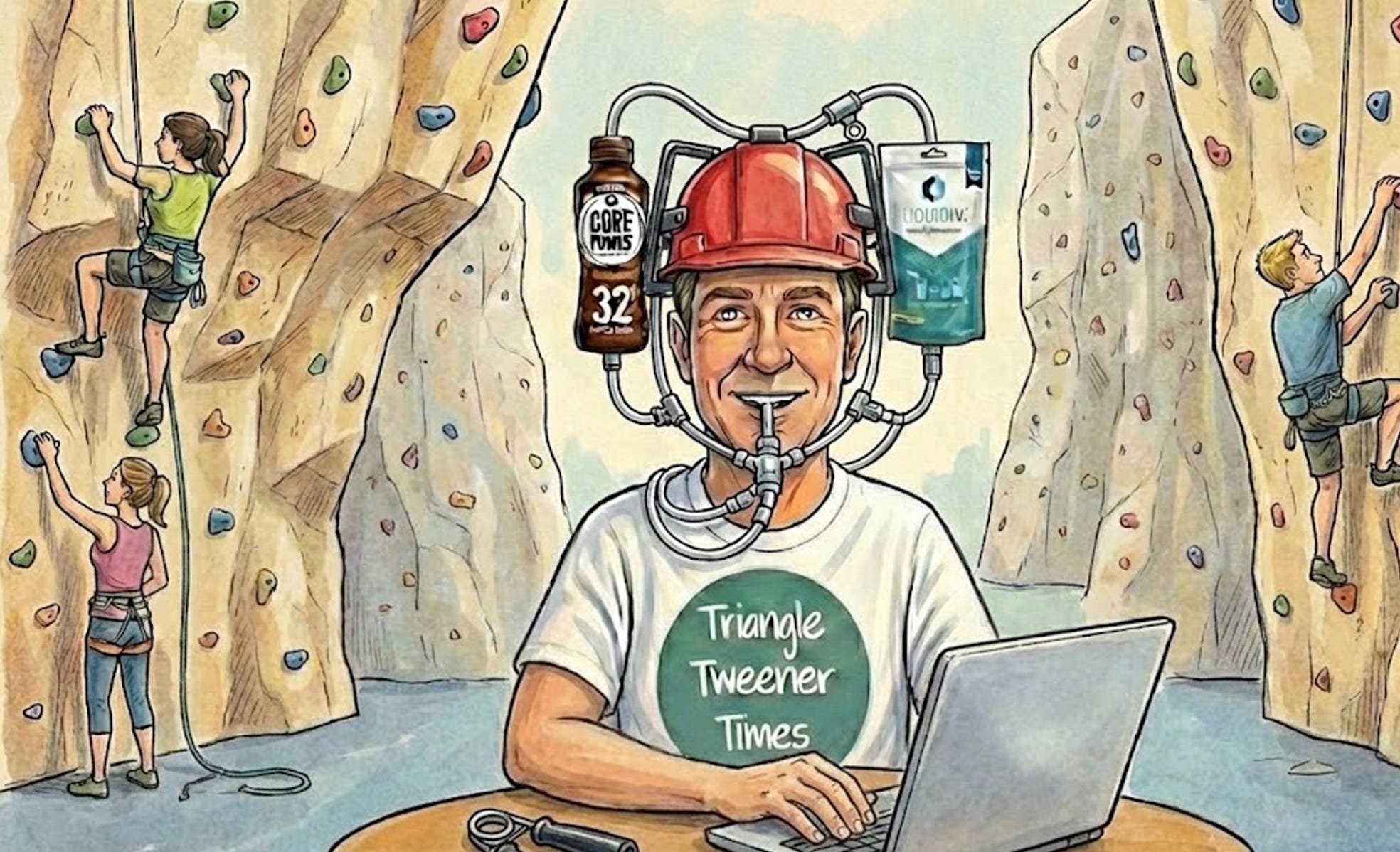
During the pandemic, I used a Tonal at home. Then I started going to a gym. Then I discovered rock climbing. Now I “co-work” at Triangle Rock Clubs around the Triangle. They have great gyms in addition to great climbing, plus strong wifi and rooms to take meetings.
Here’s my routine: In between meetings, I’ll get a quick workout or do 30 minutes of climbing. The rock climbing is a full-body workout that doesn’t feel like work. And because I’m already there to do “work,” the activation energy to exercise drops to near zero.
This is the real hack: reduce friction. Make the healthy choice the easy choice. Don’t rely on willpower. Engineer your environment.
My Health Data Stack
Here’s what I use to track everything:
Wearables:
Apple Watch (daily activity, heart rate)
Oura Ring (sleep quality, HRV)
Occasionally a CGM (continuous glucose monitor)
Testing:
Blood work every quarter through Thrive Better
Grail (cancer screening)
DEXA scans (body composition)
CT angiogram (heart)
Grip strength test
Whole body MRI
Brain testing
VO2 Max testing
Is this excessive? Maybe. But you optimize your business metrics monthly, not yearly. Why should your health be different?
Food (Without the Fanaticism)
I’m not fanatical about diet. What works for each person is highly personal. I’ve tried everything: Whole30, intermittent fasting, low carb, no breakfast, no lunch, no sugar. My diet has evolved significantly over the years.
What I’ve settled into:
Healthy breakfast
Protein bar and maybe some fruit for lunch
Well-rounded dinner
Occasional dessert
A couple protein shakes throughout the day (with fiber and/or creatine mixed in)
I monitor my weight weekly, typically measuring Thursday morning. Daily measurement is too noisy, it fluctuates based on what you ate, hydration, and other factors. Weekly smooths the noise.
Here’s the uncomfortable truth about weight loss: my 30-pound loss over 30 months looked nothing like the smooth downward curve most people imagine. It was messy. Full of plateaus. Sometimes gaining for weeks. Two steps forward, one step back. That’s normal.
The key insight: 330 days of good habits at home trump 35 days of special occasions throughout the year. Dramatic isn’t sustainable. Consistent is.
Supplements (The Honest Take)
I take a number of supplements, but I’ll be real: they help only a small amount. Most people would be fine with just a good multivitamin. If you want my full stack, check the Supplements tab on bionic.robbieallen.com.
One thing that’s more medication than supplement: Repatha. It’s a PCSK9 inhibitor that can dramatically reduce your cholesterol and ApoB numbers. Much better than a statin with virtually no side effects. The only catch is it can be expensive. This was a game-changer for my cardiovascular markers.
Sleep (My Biggest Regret)
When I was running Automated Insights over 15 years ago, I was one of those people who swore I only needed 4-5 hours of sleep per night. I’d stay up working until midnight or 1am and then get up at 5am and do it all over again. Hustle culture, baby! 🙄
It wasn’t until I started getting 7+ hours consistently that I realized something: I almost never yawned during the middle of the day anymore. I never felt sleepy after lunch.
Then it dawned on me. I was sleep deprived for all of those years. I thought I was operating at full capacity. I wasn’t even close.
If you’re reading this and thinking “but I really DO only need 5 hours”... you’re probably wrong. I was wrong for years.
YouTube Channels I Actually Watch
Want to go deeper on any of this? Here are the health-focused channels I learn from regularly:
Renaissance Periodization — Evidence-based strength training (Dr. Mike is entertaining, but his humor can be crude)
FitnessFAQs — Bodyweight and calisthenics
Andrew Huberman — Neuroscience-based health protocols
Dr. Matt Kaeberlein — Longevity research
ATHLEAN-X — Practical exercise science
Mind Pump Show — Training and nutrition
FoundMyFitness (Rhonda Patrick) — Deep biochemistry
The Meta-Lesson
The biggest insight isn’t any single hack. It’s this: “Normal” isn’t optimal.
The reference ranges on your lab work are based on average sick Americans. When your doctor says your cholesterol is “fine” at 224 mg/dL, they mean it won’t kill you this year. But optimal? That’s a different conversation entirely.
Annual checkups are health theater. By the time problems show up in basic labs, you’re already behind. Get comprehensive testing and track trends, not snapshots.
And here’s the hard truth: data without action is just expensive entertainment. The measurements don’t matter if you’re not willing to change based on what they tell you.
The Bottom Line
In 3 years, I didn’t just get healthier. I got “younger”. And I did it without extreme diets, without training for Ironmans, without becoming that guy who only eats chicken and broccoli.
Small improvements. Consistent habits. Good data. That’s the system.
After my most recent DEXA scan where I weighed in at the lowest I’ve been since college, I went out and celebrated with a Bojangles chicken biscuit. 😊 Because consistency, not perfection, is how you win the long game.
Bionic Health was acquired in the summer of 2025. Now I’m doing Executive and Longevity Coaching at Elite Medicine with Dr. Rick Hobbs. I’m always game to talk fitness with founders, so shoot me an email or DM if you want to chat.
What’s YOUR one thing you could start this week? Plus… Up Next…
What’s YOUR one thing you could start this week? Drop it in the comments. Accountability helps.
Up next, I go into software development. It’s changed more in the last 3 years than the previous 20 and it’s impossible to keep up with. Through my work in ACG, I’m using the bleeding edge developer tools and will share what I’m seeing out there on the front lines.


Fantastic breakdown of the founder health playbook. The ferritin story is genuinely alarming cause that's exactly the kind of silent issue that gets missed in annual checkups. I love the monthly challenge format too, way more sustainable than vague "get fit" resolutions. One thing though is the tracking stack feels heavy for someone just starting out, maybe prioritze sleep + 10k steps before going all in on quarterly blood panels and DEXA scans.