
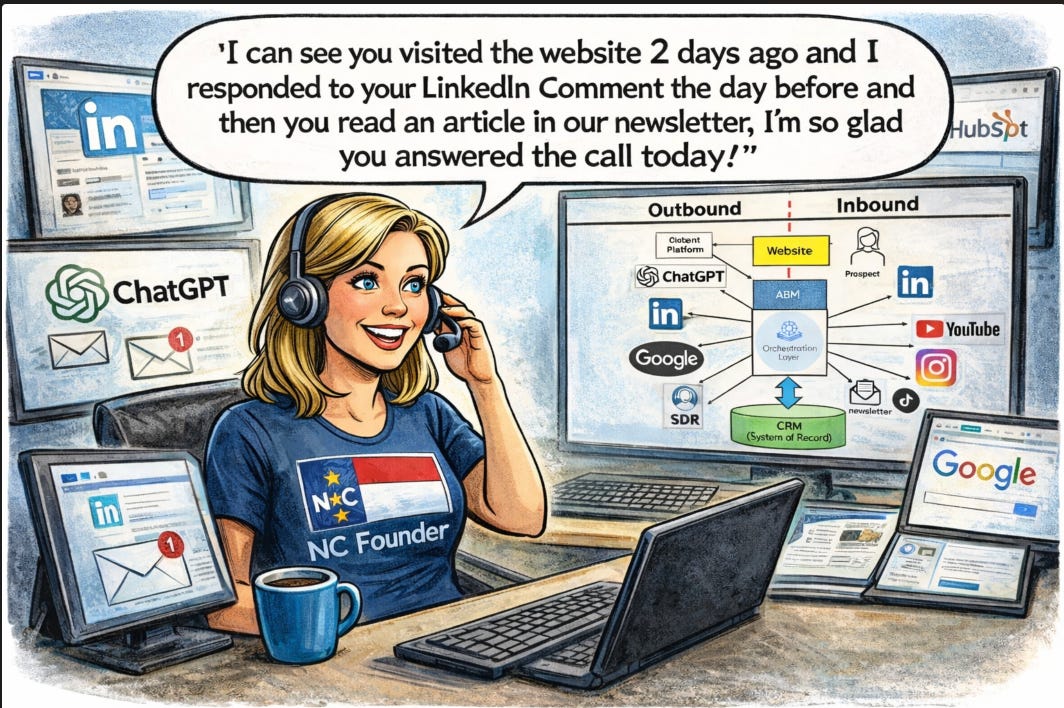
The 2026 GTM Tech Stack Playbook - A Guide for NC Tweener Founders
CRMs, Intent platforms, Orchestrators, LinkedIn Automators, Email, Smiling and Dialing - if you love GTM, grab a coffee (if you're a closer!) and come on into our funnel....
Editor’s note: Apologies for the delay on this article, the big NC IDEA deal as well as the launch of Tweener Madness extended our previous publishing plan. We’re back at it and will finish this series over the next two weeks.
This is Part 3 of a 4 part series:
Part 1: 2026 Productivity Hacks for Founders
Part 2: 2026 Founder Health Optimization
Part 3: <You are here>: The 2026 GTM Tech Stack Playbook
Part 4: <Coming next week> The 2026 DevStack for Ludicrous PR-Production
Editor’s note 2: For brevity and speed of founder-reading, we’re going to proceed with modern acronyms and terms used by founders in 2026. At the end we’ll have a decoder for those not familiar with all the concepts and acronyms.
This article is specifically focused on B2B software selling, but does cut across all ‘XTech’ categories.
We couldn’t share posts like this without our amazing sponsors:
Loving our content? It wouldn’t be possible without our amazing sponsors and our paid subscribers, so THANK YOU!
Featured Platinum Sponsor
Featured Gold Sponsor
Featured Silver Sponsor
The 2026 GTM Paradox
Here’s what founders are contending with building in 2026:
Your VC partners tell you to grow ARR faster and point to data points like Cursor, Loveable, Harvey, Replit and Gamma.
GTM is the hardest part of company building due to all the noise your ICP is being hit with every day.
There is an explosion of new GTMTech tools available
You could try them all, but that would take too long and require a dedicated resource not only to catch up but to keep-up
Companies founded after 2022, are most likely AI-native or
We asked our portfolio companies not only what they are using but also what’s really working. This is a portfolio survey, not a comprehensive Gartner report, but we think that’s what makes it useful. This is a playbook built by real-world people like you building in NC every day and using these tools as in-the-trenches operators. As a reminder, we have ~165 portfolio companies.
We’re going to go through the layers of the GTM dev stack, starting at the center and ‘working out’ in the next sections, and then tie it all together at the end.
CRM — Foundation of the GTM Stack
In our survey, HubSpot dominated the CRM category (~60%+) with Salesforce second. From there it was a long tail that included Pipedrive, Attio, Zoho, Odoo, Brevo, vibe-coding-built and the ever-reliable Excel.
Diving Deeper
We also learned
HubSpot is the default for seed-to-Series A.
Attio is the interesting challenger to watch. Two founders named it specifically as being the most ‘AI native’ or ‘model first.’
The “built our own” crowd is growing (shoutout to the founders who vibe-coded their CRM)
If you’re on Excel or a spreadsheet hybrid, you’re not being scrappy, you’re probably creating both future debt and also a situation where your GTM stack will likely fall over on its own weight at a critical time.
Founder-to-Founder Advice
Pick HubSpot and move on. Don’t spend more than one week on this decision before $1M ARR. It’s MCP friendly, they are AI-forward, its email capabilities are strong and it’s strong at pipeline management. Connect it to Claude and rock on. 🤘
Enrichment & List Building — Where the Stack Gets Interesting
For our portfolio, Apollo is the clear winner (~40%+ of respondents), Clay is the hot challenger, and then there is a scattering of ZoomInfo, RocketReach, Seamless.ai, N8N, PeopleDataLabs, and several “none/not using.”
It boils down to two camps:
Apollo camp — battle-tested, all-in-one, good enough
Clay camp — more setup, higher ceiling, the “if you’re going to do outbound right” choice and don’t need a value option.
Notable Signals from the Data
N8N shows up twice as a list-building tool vs. automation: founders are DIY-automating enrichment workflows, skipping the SaaS tax entirely. One founder is straight up testing Claude Code + MCP to build their whole ‘owned’ GTM stack. Canary in the coal mine moment… or an NIH enthusiast?
Founder-to-Founder Advice
Apollo gets you to $1-$2m ARR fast. Clay gets you further if you’re willing to invest the setup time and $ for all the waterfall enrichments.
Outbound Email — The Most Polarizing Topic and Category
HubSpot leads for email, but the “Don’t do email” crowd is real (10% founders explicitly opted out). Then: Sendgrid, Mailchimp, Smartlead, Resend, Klenty, Lemlist, Yesware, Postmark, and many are hosting their own mail servers.
The Elephant in the Room 🐘
Outbound email is getting harder. Ryan O’Donnell said it plainly: most cold outreach hasn’t worked, but referrals and conferences still work great. And he mentioned his LinkedIn automation accounts got flagged.
The Infrastructure Subplot
Triangle Founders are especially sophisticated in email marketing thanks to our Bronto heritage and Segundo being in town as well. Many are thinking about message deliverability infrastructure (Resend, self-hosted), not just the sending platform. If you’re just clicking “send” in HubSpot without thinking about domain reputation, you’re leaving results on the table.
Founder-to-Founder Advice
Email isn’t completely dead, but spray-and-pray is. The winners here have tight ICPs, strong deliverability setups, and pair email with LinkedIn touches for an ‘omni-channel’ / 360 degree approach to GTM outbound.
Outbound Calling
Increasingly rare in the world of outbound GTM is sales execs or human BDRs/SDRs cold-calling, ever since Covid (2020), the chances of getting a prospect to pick up a phone have rounded down to 0% and outbound teams are spending their time elsewhere. The companies that are doing it and having success are in very specific niches:
HealthTech - Turns out doctors, dentists, and their staff not only go to an office every day, but they answer the phone!
CROTech - If you have a solution for contract research organizations, they are also office-dwelling phone answerers.
SMBTech -Since most SMB’s are providing a service, they have to answer the phone for potential clients, and that gives sellers a chance to insert their message.
AltEnergy/GreenTech - Your Duke Powers of the world are also in the office, as they are running a 24x7x365 utility that requires a strong in-person presenece.
BuilderTech/PropTech - Again, this industry has a near 5-day-a-week in-the-office minimum, so smilin’ and dialin’ works here.
The most popular GTM tool for outbound calling/SDR/BDR work is Nooks.ai. The way it works is it optimizes the SDR’s time by dialing up to 10 numbers simultaneously, and when a live human gets on the line versus a message, it pops the SDR into that convo and pauses the rest.
LinkedIn Automation — Old Reliable
LinkedIn is a bifurcated strategy - it’s simultaneously the most effective strategy and the one where automating it is likely to get you kicked off LinkedIn or face a lengthy account suspension, which is a GTM death sentence.
Correspondingly, we had two buckets of answers..
* Bucket 1: Opting-out of LinkedIn Automation
About 30% of our founders chose this path and use Sales Navigator for some scale/targeting vs. automation.
* Bucket 2: Gently or Third-Party LinkedIn Automation
For LinkedIn automation, NC Founders are using Tarka, Dripify, Cleverly (outsourced), Lemlist, Swan, HeyReach, and Klenty.
Founder-to-founder Advice:
Don’t automate LinkedIn. The risk-reward balance is way out of whack. Instead, pick 5-10 actions a day that you can do manually per team member.
Intent — Bleeding Edge GTMTech
The whole intent category is about one thing: knowing who’s on your website before they fill out a form, because many prospects don’t go through that step any more.
In our survey we weren’t surprised to find not many folks are using “Intent Data Detection.” The founders that responded are using RB2B, Koala, Vector, Leadfeeder, and 6sense.
One founder mentioned swapping RB2B for AskSquid because, “Jason is local.” Community matters. All we can say is: 💪! (AskSquid is a Triangle-based startup.)
Editorial note: At ReFiBuy, we’re an ABM shop and using a mix of RB2B and Factors because intent signals are extremely important to how we run our GTM system.
What to do with the intent signal
Some founders mentioned having their intent system wired to Slack, and ‘reps kind of watch it’. That’s an unforced error; you have to pull the intent data back into your orchestration layer and ‘act on the signal.’ Otherwise, you’re totally missing the value of these platforms.
The free tier trap: One founder noted they’re using “just the free RB2B Slack integration.” That’s a start, but if you’re not acting on the signal, you’re not getting the value.
The Big ‘No Show’, But My Personal Favorite: GTM Inbound
I learned firsthand at ChannelAdvisor the power of an inbound content strategy. By writing a blog first and a top ecommerce podcast later, we were able to take the traffic, authenticity and thought leadership from that effort and leverage it in a ton of different ways.
The Stack Map: How It All Fits Together
Now that we have the basics, we need to point out the most important part. These aren’t just independent tools you pick up and use when you need them; they are all strategic components of a cohesive GTM system. At the heart of the modern AI-era stack is an orchestration layer.
Popular Orchestration Providers
As recently as 2023, this function lived in the CRM layer as ‘sequences’ or ‘drip campaigns’ or triggers along with a bunch of manual work in reports. It’s now very common for one of two systems to now handle that role and more:
N8N - Power-users love N8N, you can build any workflow with near infinite flexibility. Loved primarily by RevOps experts that want near infinite flexibility.
Apollo - A bit more ‘canned’ than N8N, this makes it more usable by the entire sales orgs (from SDRs to RevOps).
What do GTM Orchestrators Do?
Until I saw this layer in practice, I didn’t get it. Here’s my attempt to share the breakthrough for me. The question isn’t “What does the orchestration layer DO”, it’s more like, what doesn’t it do?
Here’s what it’s used for:
Enrichment - a lead comes in with partial info; fill that out
Sequences - More than simple email drip campaigns, follow a lead from soup to nuts and move it through a complex workflow based on status changes.
Lead scoring - Spend your valuable sales human time on high-quality leads vs. low.
Lead routing - With a bigger team, you develop complex rules of engagement and ‘who gets the next lead’ rules, and implement them easily here vs. your CRM.
Automate sales call followups- Orchestration can review a sales call transcript/call, pull out the follow-ups, and tee them up for the rep to review.
Prospect personalization - Personalize campaigns, white papers, whatever for each prospect individually and deliver that to the rep for review.
Finally, they pull in feature functions like dialers, email and calendaring so you don’t have to pay 80 SaaS fees for these little things.
Closing: The Three GTM Stack Founder/Startup Profiles
Also in the data we noticed a pattern, three common profiles that we’ve summarized here:
1. The Lean Operator
HubSpot + Apollo + HubSpot email. ~$200-400/mo. Gets the job done. Right for pre-PMF.
2. The Builder
HubSpot + Clay + Smartlead/Lemlist + RB2B + N8N stitching it together. ~$800-1,500/mo. Higher ceiling, higher setup cost. Right for post-PMF, scaling outbound.
3. The Pioneer/AI Native/Model-First Enthusiast.
Attio/custom + Clay + AI workflows (N8N, Claude Code, MCP) + intent data operationalized. $variable. High upside, high maintenance. Right for founders who want GTM as a competitive moat and have the chops to build their own pieces if they like. They are constantly wanting to ‘build their own X’ (CRM/orchestration layer/etc.)
Feedback Welcome!
What did we miss?
Which of these personas matches your setup?
Sound off in comments→
Up Next…
Robbie is up to finish this 2026 productivity series with a look at the latest and greatest DevTech. Spoiler alert: he’s already redone his stack 3X this year! What an amazing time to be a builder!


