


The Triangle Innovation Summit
Bank of America’s Triangle Innovation Summit at Apella in Durham brought together founders, investors, and ecosystem leaders from across North Carolina for an afternoon on how AI is reshaping the way companies build, raise, and grow.
Part 1 (here if you missed it) covered Dan Olsen’s keynote on product judgment, his fireside chat with Eric Boduch, and Bank of America’s economic and capital markets outlook.
Part 2 (You are HERE!) covers how three of the Triangle’s leading software CEOs are rebuilding their companies for AI, what bankers are seeing in live deals, and how regional leaders are planning for the next decade of growth.
Thanks to our sponsors for sponsoring this post:


The Great Reinvention: Rebuilding Platforms for an AI-Native World
Phil Ianniello (Bank of America) moderated a conversation with Todd Olson (Pendo), Derek Holt (Digital.ai) and Zach Maurides (Teamworks) on what it takes to turn a scaled software company into an AI-native one.
The hardest part is people
“People love progress, but they hate change.” — Derek Holt
Todd: Pendo has about 750 employees, from people who are “AI-pilled” to people saying, “I’m 50 years old, I don’t want to learn a new thing.” Those are as he puts it, “uncomfortable conversations.”
Derek: Digital.ai can take on only about three big business-process changes at a time before “the organization… rejects the change.” Recent ones were legal and closing the books at quarter-end.
Zach: The resistance is external too. College and pro coaches are “the least tech-savvy human beings,” so Teamworks has to get them to “taste the value” first.
Customers want different things
Digital.ai counts half the Fortune 100 as customers, and many operate in regulated industries that don’t reward “move fast and break things.” Todd described the range he sees. One enterprise customer fired a developer for putting Claude-generated code into production, while other customers are building entire products with Claude.
Todd is also saying no to big customers who ask for features “in UIs that I just don’t think are going to exist in a few years.” Pricing is shifting toward usage and outcomes, and Pendo will likely reprice its entire product in the next six months.
Investors want returns, and their playbook is thin
Zach said investors now want AI to show up in growth or margins, not just in feature launches. Todd was blunter. There are only four or five examples of a scaled SaaS company becoming AI-native, with Intercom’s Fin as the favorite. “None of these investors have any idea what the hell’s going on. They have pattern matching of a very small N.”
Making an incumbent AI-native
Derek: Review every recurring business process with internal forward-deployed teams: “Not can we just give everybody Claude, but can we rethink the business process.”
Zach: Teamworks works with 100% of the NFL, D1 and the Premier League and has $200M on its balance sheet. “Shame on me if we aren’t the ones that figure out how to use this technology to solve problems for this industry.”
Todd: Pendo’s new AI-native product, Novus, connects to a customer’s codebase, installs and configures itself, and fixes issues on its own. The goal is “a more magical experience.”
Where the moat is now
Own your data inputs. Teamworks bought SportLogic and PFF so it controls the data behind its player models. Zach’s analogy: “I don’t want to be buying my rare earth minerals from China.”
Solve an urgent, unique problem. Derek said more vulnerabilities were found in the first half of this year than in all of last year. About 90% of them are now exploited, compared with about 15% before, and in about a day instead of a year. “We’re actually using AI to now protect the applications from the AI.”
Product sense, speed and brand. Todd cited Lovable’s rise and Legora’s lead over Claude for legal work. Customer intimacy still matters: “Try to sell to Bank of America. Good luck.”
Hiring is changing
Todd is “incredibly bullish on young people” and is expanding campus hiring. “I don’t want your experience.” Pendo also made headlines by hiring a 23-year-old Chief AI Officer. Zach has heard of CEOs asking candidates to pull up Claude during the interview and show how they use it. Everyone agreed it feels like being back in startup mode, even at scale.
Breakout: BofA Capital Markets Deep Dive with Q&A
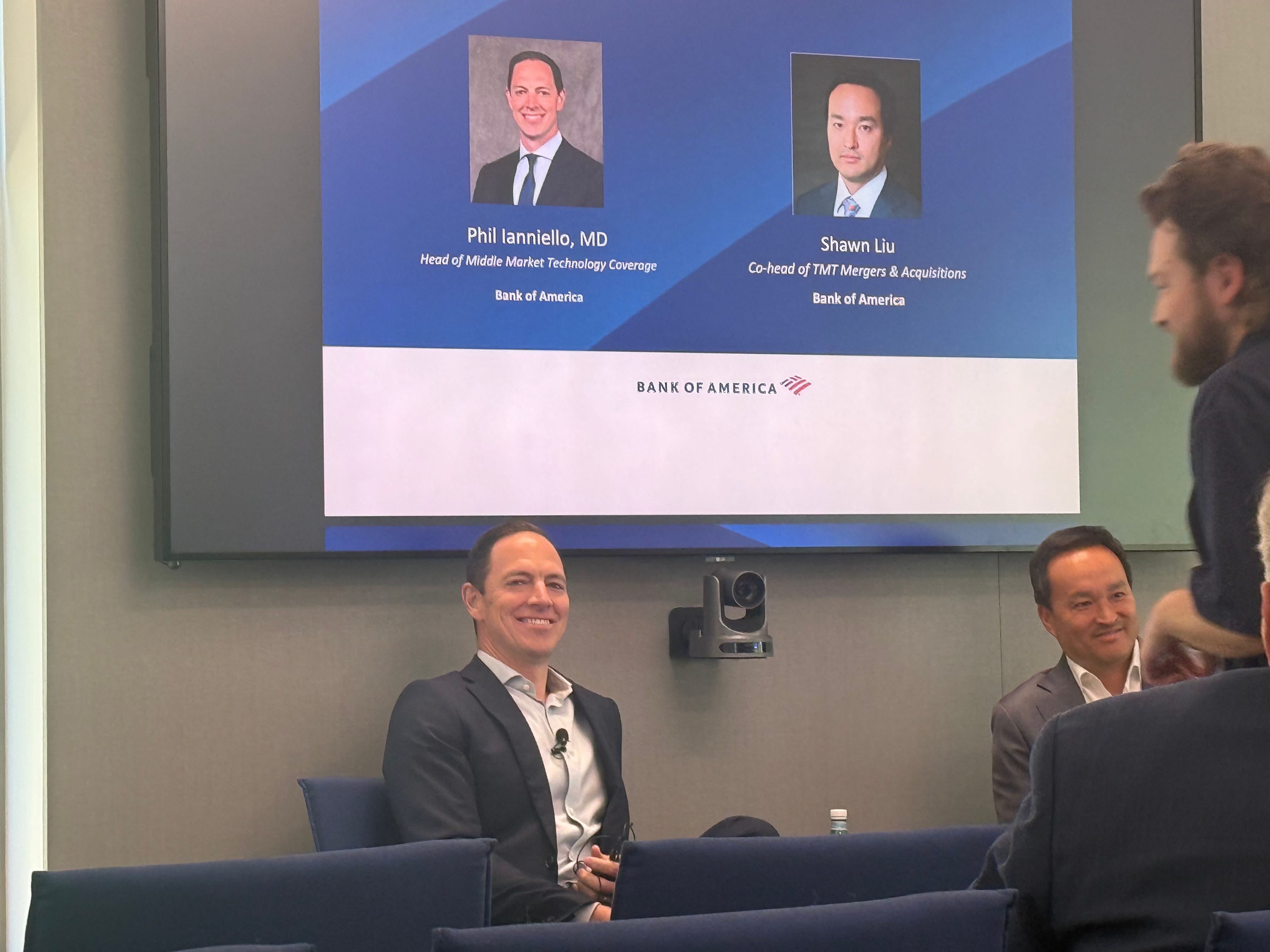
Attendees then split between two breakout sessions: “Navigating the New VC & PE Landscape” with Pappas Capital, Cofounders Capital, and Tech Square Ventures, and a capital markets Q&A with Bank of America’s Phil Ianniello and Shawn Liu. I sat in on the BofA session, which went straight to what’s happening in live deals.
Have an AI story, and back it with data. “If you don’t have an AI story when you’re trying to sell your business, that’s definitely a problem.” Even when a deal team is convinced, sponsors’ investment committees have killed deals at the definitive-documents stage because of AI headlines. Buyers expect AI-driven efficiency in operations. What sets a company apart is AI in the product, backed by KPIs such as margin gains or faster growth.
Deals take longer now. Processes that used to take 4–5 months now often take 8–12 months, with early “fireside chats” to test the story with buyers first. That means the company has to hit its numbers for two or three quarters in a row, but it also leads to smoother integrations after the deal.
Durability over defensibility. Patents and “proprietary” data are losing value as moats because AI makes copying so easy. Buyers look at customer cohorts and usage instead. “I’ve never seen so much attention on customer logins.” If a customer spent $3M on your product but their team logged in only 100 times, you will get churned.
The IPO math has changed.
The average SaaS IPO in 2021 priced at 11x revenue. Public SaaS companies now trade at about 5x.
A $200M-revenue company at 7x is a $1.4B company with only about $300M of stock trading publicly, which makes the stock illiquid and volatile.
Almost every IPO mandate is now dual-track, except SpaceX: “There’s no way you can afford it.”
Expect a wave of PE-owned IPOs around Q1, priced at a discount.
Secondaries are cleaning up cap tables. Continuation vehicles have peaked, and LPs are “getting a little bit tired of the CV pitch.” Secondary and late-stage investors are buying out early shareholders who have been stuck for years, in some cases at a 10–15% premium.
Is geography still a disadvantage? For early-stage capital, yes, and more than ever. The firms moving fastest are “probably within 10 miles of each other” in the Bay Area. Growth equity, though, is “truly global,” with investors from New York, Dubai and Singapore all at the table.
Closing Keynote: Reenvisioning the Triangle
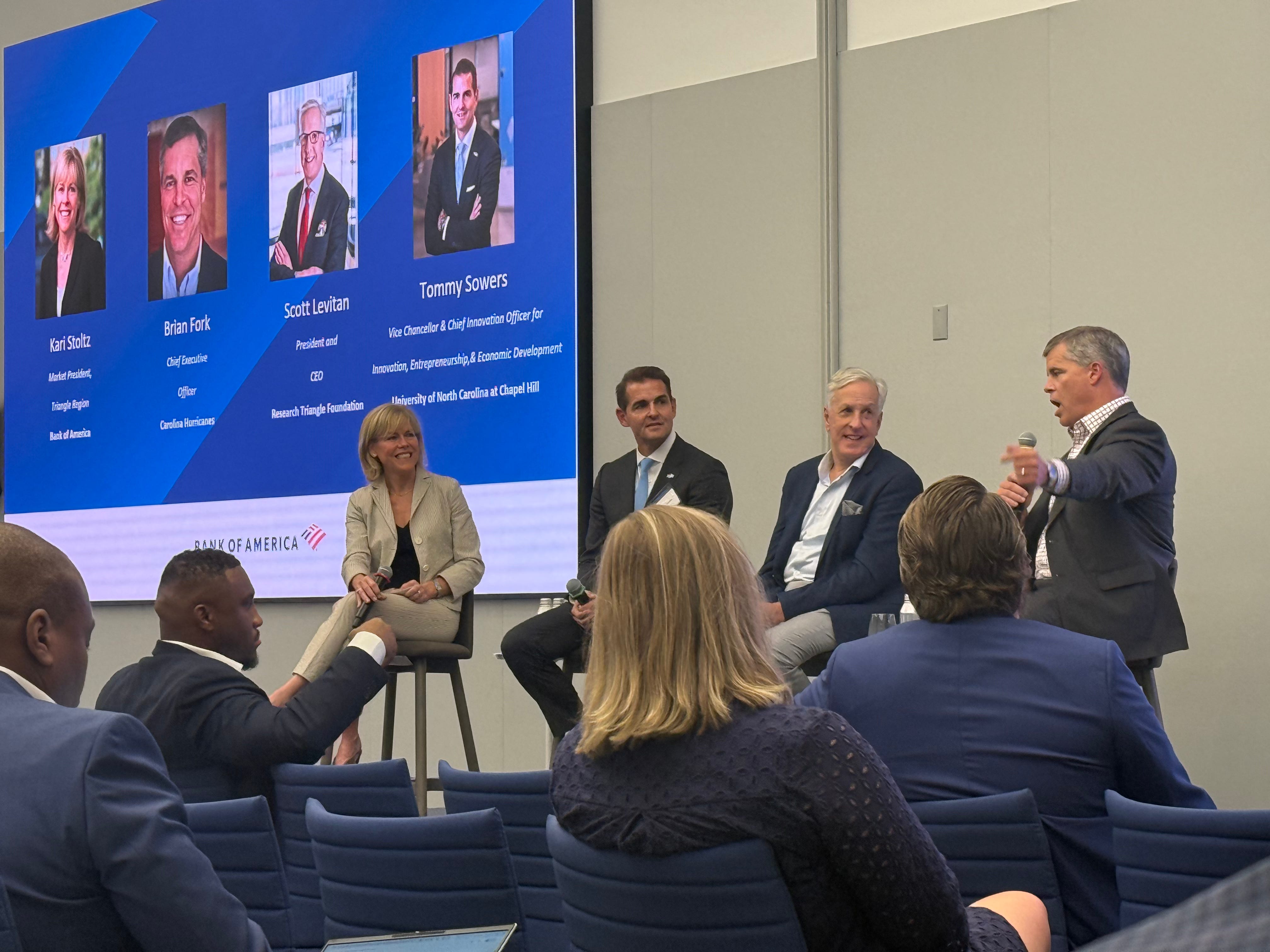
Bank of America’s Triangle market president moderated a conversation with Brian Fork (Carolina Hurricanes), Scott Levitan (Research Triangle Foundation) and Tommy Sowers (UNC-Chapel Hill) on how the region can keep up with its own growth.
Growth is the opportunity and the challenge
Scott laid out the numbers:
The region has 300,000 more residents than 10 years ago, and another 1 million are expected over the next 20 years, a 50% increase.
That means about 20,000 new homes a year, compared with about 9,800 being built today.
Scott also recalled Amazon’s HQ2 search. Amazon told the region its site visitors “only had to come one time” because every stakeholder was in the same room. In DC, it took four trips.
RTP 3.0 and Hub RTP
When RTP was founded there were three research parks in North America. Today there are 450. RTP spans 7,000 acres, about half the size of Manhattan, with ~400 companies and 55,000 jobs. It just finished a five-year rezoning with Wake and Durham counties, which Scott calls “a 50-year plan.”
Hub RTP: a 100-acre, ~$6B mixed-use downtown. It already has 440 homes, whose residents are “the first people who have slept legally in RTP in 65 years.”
Frontier Campus: a converted IBM building that now houses about a third of RTP’s companies. Its Boxyard venue hosts 400+ events a year.
Transit: 10 planned bus rapid transit routes will meet in RTP.
UNC’s “N of 1” opportunity
Tommy said UNC conducts about $1.5B of research each year, and the companies it has launched generate about $8B of economic impact annually. The next big move is Carolina North, a 230-acre site near campus that is “not to build a new industrial park and not to build a new campus, but something in between.” Asked how many RTP companies UNC has visited, Tommy answered, “Not enough.” His new pitch to corporate partners is four words: “How can we help?”
What the Hurricanes teach
Brian passed along what one analyst told him: “Every team in the NHL has an analytics department… there’s only about 3 teams that listen to their analytics department, and then there’s this team which only has an analytics department.”
“Every team in the NHL has an analytics department… there’s only about 3 teams that listen to their analytics department, and then there’s this team which only has an analytics department.”
Off the ice, the Canes are putting their 80-acre, state-owned site to use 365 days a year:
A $300M publicly funded renovation of the Lenovo Center
A private mixed-use district with at least $800M of required investment, likely $1.5–2B
A 5,300-seat music venue with Live Nation
Tommy’s lesson from the Canes: “Success in the past isn’t going to take you into the future.”
What comes next: The panel agreed the Triangle needs to plan now for transportation, housing, schools, and water and sewer. “We’ve got to be thinking 7 to 12 years from now.”
Closing Reflections
Across all three sessions, the message was the same. Incumbents rebuilding for AI, dealmakers selling through AI headlines, and a region adding a million people are all being asked to change faster than they're used to.
The Triangle's advantage is what surprised Amazon and was in evidence at the event: everyone who matters shows up in the same room!