



Day One of the NC IDEA Ecosystem Summit made the case for startups: data on new business formation, a new playbook, and 22 new grantees. Day Two looked at what comes after that. Where does the next round of capital come from? Who helps founders keep going once they’ve started? And which high schoolers in the room might be on stage at a future summit?
The agenda included teenage founders pitching to a packed ballroom, a hemp company working to bring textile manufacturing back to North Carolina, and a farewell conversation with one of the state’s longtime champions of rural communities. At lunch, our own NC Tweener Fund panel covered the gap in funding between a startup grant and a Series A.
Here’s Part 2. (Missed Part 1? Check it out here!)
Thanks to our sponsors for sponsoring this post:


The morning: engines, policy and a farewell
A welcome from the Endowment. Sophie Dagenais, President and CEO of The New Hanover Community Endowment, opened the day. The Endowment was the summit’s community sponsor and had a large presence in Wilmington all week.
Three NSF Engines, one state. North Carolina is the only state with three NSF Regional Innovation Engines: textiles, regenerative medicine and grid modernization. Thom Ruhe had joked on Day One that most states are “a mile deep but only a foot wide,” while North Carolina is “as wide as we are deep.” On Day Two, leaders from all three engines took the stage: Anne Wiper of the Textile Innovation Engine, Jesse Thornburg of the RegenMed Engine, and John Daniels of UNC Charlotte. Melissa Sharp of the Textile Innovation Engine moderated. They covered the technologies and companies coming out of each engine, and how founders and support organizations can get involved.
A view from Raleigh. State Senator Michael V. Lee of North Carolina Senate District 7 gave remarks mid-morning. That gave the room a chance to hear directly from a legislator after a day of calls to put more public money behind startups.
Scott Hamilton’s farewell. Golden LEAF Foundation President and CEO Scott Hamilton is retiring after nearly three decades of work on rural economic opportunity in North Carolina. In his fireside chat with Ruhe, he talked about that legacy and about Golden LEAF’s next chapter. That includes the $10 million investment in NC IDEA to bring its entrepreneurship programs to rural counties. Ruhe had previewed that announcement on Day One in response to a founder from eastern North Carolina. Her question was whether anyone was investing outside Raleigh, Charlotte and the mountains, and this grant is a big part of the answer.
Entrepreneur Spotlight: Renaissance Fiber
Daniel Yohannes, CEO of Renaissance Fiber, started with a fact: about 90% of the world’s hemp textiles come from China. Renaissance Fiber isn’t trying to invent a new material. It’s trying to build hemp textile production at scale in the U.S. Yohannes admitted that makes the company “less sexy to investors.” He still sees it as part of a long state tradition.
“We are an inheritor of North Carolina’s long tradition of transforming stuff that is grown from the ground into manufacturing, whether that’s textiles, cotton, tobacco or sweet potatoes.” — Daniel Yohannes
The company’s story shows how grants can build on each other:
NC IDEA’s SEED grant funded the first experiments. They took place on co-founder Mike DeLong’s family farm in Yadkinville, using totes, sieves and a homemade gantry to “degum” hemp at about 50 pounds per batch. The grant also paid to transfer the process to a large Southeast dye house, where it now runs at the metric-ton scale.
Recognition and runway. The process made Renaissance Fiber a finalist for the Biomimicry Institute’s Ray of Hope Prize. A grant in Winston-Salem then gave the team a home in the Innovation Quarter.
NC IDEA’s Black Entrepreneurship Council award helped the company win two U.S. Army SBIRs as a hemp supplier. One was for vehicle seat fabric and the other for lightweight camouflage netting. The war in Ukraine has shown that polyester netting stands out on drones’ infrared cameras, so the Army wanted bio-based alternatives.
NC Biotech’s Bioneer Venture Challenge paid for a factory up the Cape Fear River from Wilmington. That factory made the fiber for the first Patagonia product made with U.S.-grown hemp. The hemp was grown in Minnesota by the Anishinaabe.
A $250,000 loan from Invest Appalachia and the Fibers Fund helped unlock $2 million in additional capital, including an SBA-backed line of credit. That money built what Yohannes called the nation’s first fiber processing factory of its kind, in Mocksville.
There’s still a catch. Renaissance Fiber currently buys all its raw hemp west of the Mississippi, even though North Carolina farmers want to grow it. So the company helped start what Yohannes believes is the state’s first industrial hemp co-op, the Piedmont Agricultural Innovation Collective. About 15 farmers have joined so far, and Renaissance Fiber is now raising money for a processing center in Davie or Yadkin County.
Yohannes described the company’s funding as a “belief timeline”: first the founders believe in it, then friends and family, then someone outside has to believe too. For Renaissance Fiber, grants were that outside believer. They led to almost $1 million in convertible notes and Department of Defense funding, and then to the $2 million round. “Patient capital,” he called it.
“We believe hemp is the future of natural fiber. Thank you, NC IDEA, for believing in us.” — Daniel Yohannes
Featured Lunch Panel: The Tweener Landscape
Full disclosure: this is our panel. We’re the NC Tweener Fund, so expect some bias. We’ll stick to what was actually said on stage.
NC IDEA has given out grants for more than 20 years. For almost as long, Thom Ruhe has wanted a way to also invest in the companies that go on to succeed. This year that idea got real: the NC Tweener Fund, Powered by NC IDEA, went statewide. In the intro, the room heard that the fund is already investing well beyond the Triangle. Moderator Ben Redding, NC IDEA’s CFO, then brought up the fund’s two general partners.
The two GPs
Scot Wingo called himself “a serial entrepreneur by day” and “a nerdy Batman” by night. He has started five companies. The best known is ChannelAdvisor, which he founded in 2001, took public in 2013, and grew to about 1,000 employees in the Triangle before it was acquired by private equity. He started the Tweener List in 2015 and the fund in 2022.
Robbie Allen is on his fourth AI company. He picked AI as his specialty in college, back when, as he put it, saying “artificial intelligence” made people start yawning. Robbie has his own NC IDEA history. A grant in 2009 paid for a full year of operations at his first startup. He was one of the fund’s first LPs in 2022 before joining Scot as a GP.
Why build a list of “tweeners”?
The Tweener List started as a fix for Scot’s inbox. As more people moved to North Carolina, he kept getting the same request: my friend is moving to your area and wants to work at a startup, who should they talk to? He assumed someone had already made that list. Nobody had.
It also matched where he felt he could help most as a mentor. With a napkin-sketch idea, he said, there isn’t much he can do. “It’s not a fun coffee meeting if you want me to just crap on your idea and tell you your baby’s ugly.” Companies at around $1 million in revenue were different. That’s when he could stop founders from making the classic mistake.
“I just got to $1 million, I’m going international, I’m launching five more products. And I’m like, whoa, that’s the exact wrong thing to do. You need to get to like $10 million before you even think about international.” — Scot Wingo
He couldn’t exactly call founders and ask for their revenue, so he found a proxy. On LinkedIn, high-tech companies with 11 to 50 employees are almost always at about a $1 million run rate. He built what he called “an agent back in the day” to scrape LinkedIn company pages. In 2015 it found 45 tweeners in the Triangle. Today the Triangle alone has 250 to 300.
A company has to meet four criteria:
It’s a tech-enabled product business
It’s headquartered in North Carolina
It has more than $1 million in revenue or 10 or more employees, up to about $50 million in revenue
It doesn’t need FDA approval. “Biotech’s amazing,” Scot said, but it’s outside what two software guys know. Deep tech is welcome.
The list has had some benefits nobody planned for. Scot gets about 10 calls a month from investors outside the state who found the list and want introductions. Large North Carolina companies like IBM, ABB and Schneider use it to find technology partners. And job seekers still use it the way it was first intended.
Why an index fund for startups?
The fund started with an idea Scot initially said no to. A local crowdfunding group wanted to launch a “Tweener List crowdfund.” He told them to go ahead but leave his name off it. Still, he kept thinking about a version for accredited investors that would follow the same logic as his own portfolio.
Warren Buffett tells most people to skip stock-picking and put their money in an S&P 500 index fund. Scot thought the Tweener List could serve the same purpose for startups: an index with a fund that invests across it. Before launch he had about $10 million in commitments from fellow entrepreneurs. He said the fund addresses three problems:
The seed gap. As North Carolina’s venture funds have grown, they’ve stopped writing small checks. “Pre-seed and seed has dried up.” Instead of just complaining about it, Scot said, entrepreneurs should do something about it.
New investors on the sidelines. ChannelAdvisor’s IPO created about 30 millionaires, and many of them wanted to back startups. But traditional local funds can have minimum checks of $400,000. Scot said risk capital should be under 10% of someone’s net worth, more like 5%, “unless you just eat risk for breakfast like we do.”
Diversification. An angel who writes one $50,000 check has all that money in one company. Robbie noted that studies suggest angels need about 50 companies to avoid being too concentrated, which is nearly impossible to manage part-time.
Here’s how the fund works:

“It’s the easiest way to get into angel investing with the most diversity.” — Scot Wingo
Redding explained what NC IDEA gets out of it. NC IDEA is an LP in the fund, and any returns go back into its work across the state. He was clear that NC IDEA invested because it believes in the model, not just for the returns.
Going statewide
The list went statewide in January, and the fund followed. Robbie, who is from Burlington and has lived in Winston-Salem, said he expects the fund to eventually invest more outside the Triangle than inside it. The numbers already point that way:
14 investments outside the Triangle since the NC IDEA partnership was announced
Half or more of each quarter’s new investments now go to companies outside the Triangle
The hard part is finding the companies. Robbie said there’s no complete database of tweeners, not even Crunchbase. Every year they find tweeners that have been quietly growing for years without press coverage. Multiply that across 100 counties and there are a lot of companies to find.
The young founders in the room
The Youth Summit pitchers were in the audience, and Scot spoke to them directly. At 17, he said, he “was not on a path that would lead to success.” He mostly played video games and had a Lamborghini poster on his wall. His frustrated father slid a copy of Fortune across the table with a cover asking how Bill Gates made $100 million. The answer was that Gates took a company public. Scot decided that day he would do the same. “I worked on that for like 35 years, and I did it.” He also pointed out that he went to neither Harvard nor Stanford. He grew up in Aiken, South Carolina, a town with two stoplights and a one-screen movie theater.
Robbie’s father worked in manufacturing at AT&T. Robbie grew up thinking entrepreneurs were rich people who went to Ivy League schools. It took moving to Silicon Valley before he felt he had permission to start a company. Now, instead of a college fund, his kids have what he calls an “after-school fund.” They can use it for college, or he’ll be the first investor in a company they start right out of high school.
“It’s not book smarts. There was nothing about MIT that really enabled me to be an entrepreneur. It’s really a willingness to put in the time and effort and the ambition to do it.” — Robbie Allen
Scot’s last offer was to the teens: connect on LinkedIn (”I know it’s not Snapchat”), and lean on Jim Roberts. “If you said, Jim, I need you to break through that door, he would. There’d be a Jim-sized silhouette in that door.”
The Youth Summit: Wilmington’s next founders
Five teams of high school founders from Cape Fear Academy, Laney High School and Sea-Tech High School pitched in two rounds during the morning. Heather McWhorter, Director of UNCW’s Center for Innovation and Entrepreneurship, moderated. The New Hanover Community Endowment introduced the competition.

The winners were announced after our lunch panel, and the judges were clearly nervous about getting the oversized checks into the right hands. Before the top three were named, Thom and Jackie Ruhe announced a personal gift through UNCW. In the words of one presenter: “Not one of these kids is going home empty-handed.”
As Scot put it after the announcements: “They get younger and younger every year.”
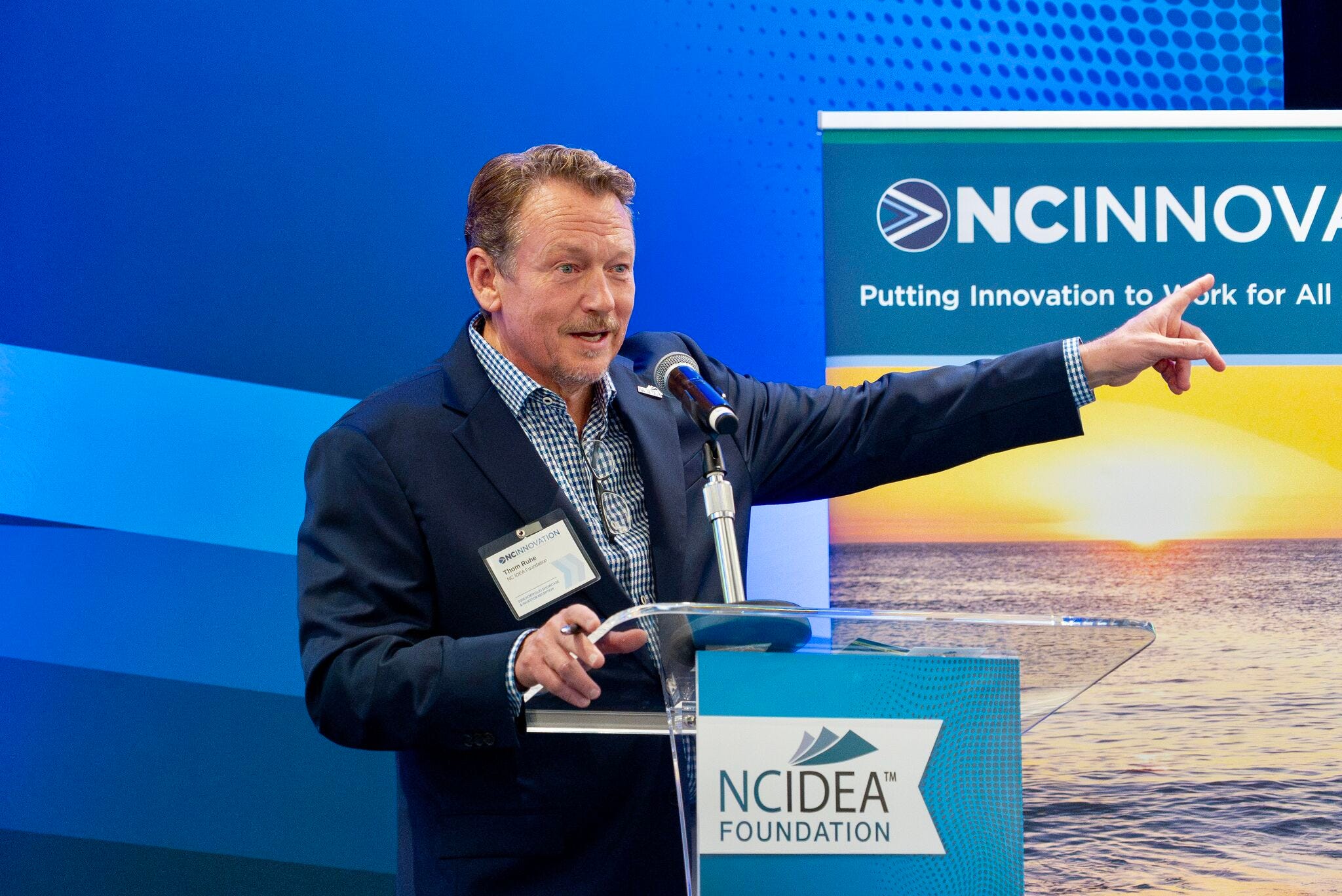
Photo Courtesy of NC IDEA
The afternoon: survival, local assets and a send-off
No Wrong Door. North Carolina has plenty of organizations ready to help small businesses. Yet 37% of aspiring business owners say they can’t find help. This panel looked at why. Michael Buckovich of Vision To Venture moderated, joined by Dr. Caroline Glackin of UNC Pembroke and Tom Snyder, NC IDEA’s VP of Programs. They shared statewide research and new data on business formation, focused on three goals: reaching businesses earlier, getting owners financially ready sooner, and helping more of them become self-sufficient. It tied back to Dane Stangler’s point on Day One: a business application is only the start, and the work is in helping those businesses survive and grow.
New Hanover’s innovation assets. The last panel stayed close to home. Southeastern North Carolina has a large community endowment, maritime cybersecurity research at UNCW’s MCARTEC, and an active startup community. Terri Burhans of The New Hanover Community Endowment moderated. She was joined by Dr. Ulku Clark of UNCW and MCARTEC, Jerry Coleman of the Cape Fear Small Business Center, and Dr. Karl Ricanek of UNCW. They talked about how philanthropy, research, entrepreneurship and academia are working together to build the region’s ecosystem. Coming after Day One’s “family tree” panel, it reinforced Jim Roberts’s point that Wilmington is more than a beach town.
Closing remarks. Thom Ruhe closed the summit. On Day One, he had promised “a big announcement” to anyone who stayed until the end.
What Day Two added up to
Day One argued that North Carolina should invest in startups. Day Two showed what that investment builds over time:
Grants work best in sequence. Renaissance Fiber went from an NC IDEA grant to Army SBIRs, a Patagonia product, and a $2 million round. Robbie Allen went from an NC IDEA grant to his fourth AI company and a seat as a GP of an NC IDEA-backed fund.
The funding gap has moved. Grants help companies start. The harder stretch now is pre-seed and seed, as North Carolina’s larger funds write bigger checks.
The rest of the state is getting attention. That includes Golden LEAF’s $10 million for rural entrepreneurship and Tweener Fund investments outside the Triangle.
The next generation is already pitching. Some of the teenagers in the room could be on next year’s Tweener List.
How to get involved with the Tweener List and Fund
If you read this far, here are three ways to help:
Tell us about a tweener. We’re already building next year’s NC Tweener List. If you know a tech-enabled product company headquartered in North Carolina with more than $1 million in revenue or at least 10 employees, and it isn’t on this year’s list, let us know. We especially want to hear about companies outside the Triangle.
Point us to companies that are almost there. If you run a support organization and know a company at roughly $20,000 to $30,000 in monthly revenue, send it our way for the watch list.
Become an LP. The NC Tweener Fund is a rolling fund that’s always open to accredited investors. A one-year, $30,000 commitment, with IRAs and 401(k)s accepted, spreads your money across about 40 North Carolina startups. You can reach Scot or Robbie on LinkedIn or through NC IDEA.
Thanks to NC IDEA, The New Hanover Community Endowment, every sponsor, and the whole Wilmington community for two great days at The Lumina. See you at the next summit.