
Part I/II: Triangle Startup Venture Funding Trends and Analysis: The Triangle’s First and Only, Authoritative Guide to Valuations, Deal Terms and Investment Vehicles.
One of the benefits of our index strategy at Tweener Fund is we see every deal in the Triangle and participate in most, so we have a near perfect view of what's going on. Let's dig in!
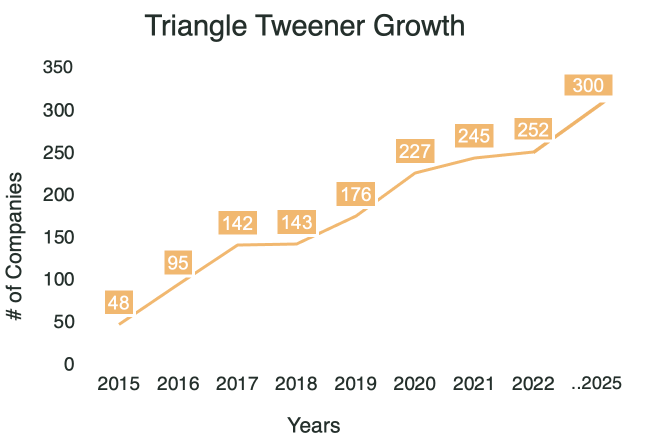
Ten Years ago this year, I started the Tweener List. It started with 50 companies and now has 300+→
We couldn’t share posts like this without our amazing sponsors:
Loving our content? It wouldn’t be possible without our amazing sponsors and our paid subscribers, so THANK YOU!
Featured Gold Sponsor
Featured Silver Sponsor
2025 Sponsors
ExtensisHR - As a Professional Employer Organization (PEO), ExtensisHR empowers tech founders and growing businesses to scale smarter. We take HR administration off your plate—managing payroll, recruiting, employee benefits and retirement plans, compliance, risk, and more—so you can focus on innovation. For over 25 years we’ve leveraged a people-first approach, customer-centric mindset, and deep industry expertise to ensure employers have the tools needed to stay competitive in today’s market.
Tweener Fund: 2022 Private Company Index Fund Launch
Back in Jan of 2023, we launched the Tweener Fund. The idea was to create an ‘index fund for private companies’ focused on those from the Tweener List. The public company analogy would be Vanguard that built this idea of an index fund that tracks the S+P 500 that has now become more popular than traditional mutual funds that ‘pick winners’.
As part of this index strategy we set the goal to invest in as many of the ~300 Triangle Tweeners as possible. Some are bootstrapped and some are later stage, so we knew that 300 wasn’t possible, but 200 was definitely do-able.
Here we are 4 years later and we’ve:
Invested $11.2m in…
Over 165 companies (100% Triangle based!)
completed over 222 deals - 222-165=57 - these are add-ons where we’ve doubled down in companies with rapid revenue growth at least a year past our initial investment.
I’d be remiss if I didn’t point out this was all possible thanks to our awesome investors who are people in the startup community that are accredited investors that want to ‘pay it forward’ with us. Over the life of the fund we’ve had 300 LPs contribute and have 100+ active each quarter. The design of the Rolling Fund framework we use has a low 1 year annual commitment of $30,000 so is designed to have ‘LP graduation’ and new LPs added all the time.
In fact -we’re always open for new LPs, if you’d like to learn more, click here (accredited investors only pls)
The SINGLE most Frequently Asked Question from Founders…
Robbie and I probably talk to 10-20 founders a week and have for 3yrs. That’s a lot awesome conversations (we have best job EVER) and the single most frequently asked question we get is:
“I’m looking at raising capital, what are valuations in the Triangle for <my company’s revenue/scale/space/growth>?” - Triangle Founders Every Day.
It’s a good question and this post is going to answer that question!
Transparency and Founder Focus
Part of our DNA at Tweener Fund is to always help founders and be as transparent as we can. Examples of this at work are:
Every Q we disclose all of the companies we’ve invested in (with their permission), the amount invested in the Q and trend data around investment vehicle, etc.
We highlight founders in our new and already popular "Founder Spotlight” series (Here are Extellis and Xander for example).
Tweener Talks - Our very popular audio and video pod featuring honest stories from founders like you - local and they all started as first-time founders.
Tweener Madness Our annual Spring ‘March Madness’ inspired pitch competition - I’ve had SOOO many founders tell me that watching other local founders pitch is the most helpful tool they’ve found for upping their own pitch game. This was a happy unintended consequence from the contest.
Finally, THE definitive answer to the valuation question!
Because we now have enough data to make sure no individual company’s valuation can be backed into we are going to start providing much much more valuation data on Triangle Startups. You won’t find this in Carta data or Pitchbook or Crunchbase, but because the way our model works we look at and invest in 90%+ of every Triangle non-biotech startup fundraise. From Pre-seed to Series B, we see it all. In fact we’ve got 222 datapoints that we are now going to share (in summarized anonymized form) to give founders the exact details on:
Most popular Investment vehicle by stage
Valuations, amount raised and other details per stage
Ranges of various stages and amount raised
This data allows us to now come out with the authoritative, 100% accurate Triangle valuation and fundraising guide.
A Note On Round Naming/Stages
It’s becoming popular in Silicon Valley to have much larger earlier rounds and also most VCs ‘name’ the round by amount raised. Instead, as operators, we think of the rounds as the company’s maturity.
For example, if a company raises $4m - a VC will call that a seed even if the company doesn’t have a product or revenue. We call that a pre-seed.
Here’s a guide to how we name these:
Pre-seed - Basically a pre-tweener - company is either just getting founded or has a product and some early customers, but little to no revenue traction yet - not through PMF.
Seed - The company is through PMF or can see the light at the end of the tunnel and ready to get past founder-led sales. Usually has ‘line of sight (one or two quarters) to $1m ARR
Series A - The company is well past $1m ARR and looking to really blow out the GTM motion. It knows the next 10 hires, the next 10 features, can tell you every nuance about their ICP - where they live, where the sleep, what type of desert they like, favorite movie. Really ready to scale.
Series B- Typically north of $10-15m ARR, ready to explore TAM expansion, maybe some light international expansion.
That’s as far as we go and our focus is earlier, so we won’t be going into the C/D/E side of things.
Details on the Dataset
The 222 investments we’ve made over the last 4 years can be broken down by stage this way:
Let’s look at this by stage:
Pre-seed - We’ve made 71 pre-seed investments, representing 32% of the deals and 23% of the capital invested ($2.5m). When we invest earlier our checksize is smaller than our average $50k coming in at $35,713.
Seed - Our sweet spot at Triangle Tweener Fund! We’ve made 106 investments (47% of deals) representing 49% of $’s invested ($5.3m). Here, as expected, our check size is right at the $50k target
Series A - 27 deals or 12% of our deals but 16% of the capital ($1.7m at $65k average check size). The bulk of these are from companies in the 2022/2023/2024 investments that grew fast and raised add-ons.
Series B and C - Somewhat rare for us coming at 18 deals together or under 10%, these are companies where a founder we’ve known has let Tweener Fund invest a bit later in their company than usual and we’re happy to do it - most of our early awesome exits have come this cohort. It represents the last $1.2m or 12% of our invested capital.
Total Data Set - Swirl that together andw e now have 222 deals for ~$11m with an average investment right around $50k.
The best thing, we know the deal terms for every single one of those deals and that’s the dataset.
Coming in Part II: The Triangle’s Authoritative Guide to Current Valuations, Deal Terms and Investment Vehicles.
With that pre-amble and explanation of where the data comes from and how we categorize it and the ‘data density’ - next week we’ll be releasing all the insights from the largest pool of Triangle startup fundraising data on the planet!
Subscribe now so you don’t miss it!


