


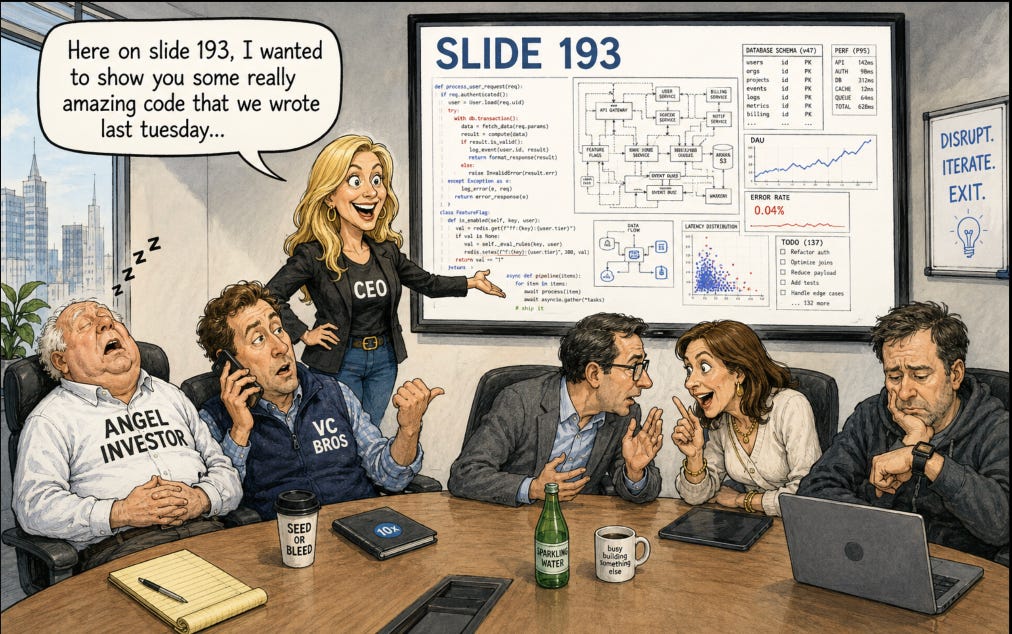
Three things happened recently that inspired the idea for this one:
First, at ReFiBuy, we completed our Seed round on May 5th. With the completion of this round we had a board and thus, recently had our first board meeting. I haven’t had a first meeting since 2014 and it was fun to think about how to start out fresh, how to streamline the process, etc. I did the rough math on this and I’ve led ~180 board meetings and been at another ~250 - that’s a total of 430 board meetings!
Second, one unanticipated awesome thing about running Tweener Fund is that as of this writing we are on the cap table of 188 companies. We receive quarterly shareholder updates from all of them. Robbie and I were remarking the other day how fascinating it is reading these, they tend to fall into these four buckets:
5% - really amazing operators, I learn something from all their updates
20% - Decent updates, usually they take a 10yr old YC template and yolo it
25% - Terrible updates (we’ll go into this later)
50% - Can’t get their investor update on a regular update, or at all.
Finally, I read this article from NFX, quaintly titled→

As I started writing, I kept going back to that ‘pyramid of kind of lame quarterly updates” and thought, NC founders, need to really up their game on all investor relations and communications, so we’re going to make this a 3 part series:
Introducing the Investor Relations/Comms Strategy for NC Founders Series
Investor relations are critical. These people and their LPs have invested their two most scarce resources: time and treasure into your company to support YOU the founder, in addition to building a great company, one of your top responsibilities is to keep them updated. Who knows, down the road, you may hit a rough patch and need more capital. Also every existing investor is aligned in helping you solve problems, hiring and raise more capital. If you don’t keep them updated on the business, how are they supposed to do that? It seems like a lot of work, but over the years I’ve built a system that ‘waterfalls’ the information so you only build it once and then tweak it for each step of the waterfall. Not coincidentally, these steps in the waterfall are going to be the sequence of our articles in this series:
IR Comms waterfall step 1: Quarterly Board meetings (Part 1/3 of our series)
Optional: monthly Board update email - I call these FLASHs
IR Comms waterfall step 2: Quarterly Shareholder Updates (Part 2/3 of our series)
IR Comms waterfall step 3: Team Update and All Hands meeting (Part 3/3 of our series)
Company Phase Impact on Board Meetings
At ChannelAdvisor I had 19yrs of board meetings. We went from a board of 3 (2 founders and one VC) to a public company board with 9 members. Those are very different board meetings. For the purposes of this post and the whole series, we’re going to assume we’re talking about Seed/Series A level companies. Once you get to B, your board gets bigger, you usually have to do audits which means committees, might as well have a comp committee too, it gets way more complicated at that phase, so we’ll stay under that.
The Big Picture - How to THINK about Board Meeting/IR Comms…
Your mental framing for this should not be: UGH, I could be doing X/Y/Z and now I have to do a stooopid board meeting, what a waste of time! If this is your approach, you’re guaranteeing the meeting will suck and it will be a self fulfilling prophecy - a waste of everyone’s time.
Instead, the right framing is: This is an opportunity each Q for the leadership team to poke our heads up, think outside the day/week window execution envelop and look at how we’re doing against our 2-3yr plan, our 1yr plan and our 6 month plan (I’ve found in the AI Era I have to focus on this duration as the 2-3yr window has too much cone of uncertainty to worry about). An artifact of this exercise if you think this way is that it becomes a team activity instead of a hero’s journey. It also always surfaces news you may have missed, or rough edges you didn’t were forming. These can be a customer that’s not happy, one of your team not really aligned with something, etc.
I also love ‘content re-use’ and I’ve found not only does the board meeting exercise generate 3 pieces of content (board/shareholder/company) it also almost always spits out a slide or two or the kernel of an idea that works its way into a piece of content I write, a ‘next round’ pitch slide, or a customer deck.
In the age of agents, if you’re spending over 4 hours creating board materials, you haven’t automated or delegated enough of your operations. The financial package and basics should just be outputs of your financial closing process. Your GTM engine should be producing material you can just grab and polish/cherry pick, etc. At a meta-level a good board process forced to be 2-4hrs will make the whole systems of your company better - another opportunity in the process!
Cadence, Length and Format
For an early stage business, quarterly board meetings are the right cadence. Timing-wise, I like to tie Quarterly board meetings to company calendar quarter operational cadence. It typically takes 2-3 weeks to close out the Q, so you are looking at:
Q1 results meeting - April 14-30
Q2 results and 1H meeting - July 14-30
Q3 results meeting - Oct 14-30
Q4 results and 2H, year recap meeting - Jan 14-30
Format-wise, if you have local investors, they should all be in-person. If you have investors outside the area, I like the cadence of 2 remote (I prefer Q2 and Q4 in-preson, those are big half year/full year updates and worth of more time and attention). Another pro-tip, for one of those meetings, go have it at your lead investors HQ - meet the partners, stay front of mind. These people will hopefully be investing more, you want them to remember you and you want them to have a favorable perspective.
Duration
Early stage, 90mins is ‘ok’ - shoot for 60mins if you can. We live in an era of fleeting attention spans. Board members read materials (if they don’t they aren’t good board members and you should tell them that and ask them to read the materials next time - they hold you accountable, you can hold them accountable.
If there’s a pie-chart of the time, 10% of that pie chart should be on boring slide review, 90% should be on strategic discussion. It’s hard to get there, but trust me, you can if you follow the up-coming best practices.
Exceptions to the rules
The one override to all this is if you are running low on capital - let’s say less than 6 months run-way, you should go into monthly board meeting ‘war-time founder’ mode and have monthly 30min meetings with one topic: fundraising status.
Cadence/Scheduling best practices
Avoid Mondays and Fridays - VCs have partner meetings on Monday and three day weekends eat up Fridays.
Get your board calendar out early (oct/nov) - On average, VCs sit on 4-6 boards. If we have a window of April 14-30, that’s two weeks, 8 days -it’s a race to grab one of those windows on the prime 8 days. VCs call these windows “board season”.
Best Practices
Let’s start with the ‘what to do’ - best practices I’ve assembled both running and attending those 400+ board meetings:
BP1: Tone and Framing of the Board Meeting
This goes back to the mindset, but that was the meta, now we’re one level in. The one mistake many first time founders make is they treat a board meeting like a ‘meeting with the boss’. They ask the board: “How do you think I’m doing?” they want the board to make hard decisions or even mundane decisions. This does not show leadership and it does not build confidence in the CEO and team.
Instead, the setup in my mind is you have people on the board that see a wider field than you do. They’re on lots of boards individually and their firm is on usually 10-20 companies. They can help with lead gen, fundraising, recruiting and even are a sounding board on strategic decisions.
The tone of the board meeting should be: “Here’s what happened in the last Q, here’s where the next Q is going, here’s where the rest of year and maybe next year are trending. Here’s some things that went our way, here’s some that didn’t and here’s what we’re doing about it. Finally, here’s where we could use your input, your help, your shared wisdom.
BP2: Pre-pre-read
7 days before the end of Q, I like to email the board - Hey, we’re starting to prep for the board meeting, any topics you want us to prioritize? For example, in my first board meeting, one of our investors had seen a surge in potential competitors - they wanted to share what they were hearing, see how we thought about it, learn who we were encountering and talk about that. This was super helpful feedback, because this was NOT on my initial mental agenda. I ended up with a great competitive analysis framework out of the process too! (content re-use - yeah!)
BP3: Pre-read
At least 48hrs before the board meeting (2 full biz days) I like to send the pre-read out. The pre-read includes:
The board deck (don’t change after you send it, it needs to be done/done/done).
Financials
Anything else - some folks send out some customer-level detail, future budgets, a report from the GTM/Product/Admin sides of the biz
A well timed and formatted pre-read sets the tone with the board that:
You are on your game, YOU are taking this seriously and you expect them to
You expect board members to read these materials
You have given the board ample time to do this.
THIS board meeting will be different than the majority that don’t take this seriously.
PB4: Board Agenda
We’ll cover the why on this one in the ‘what not to do’ and this is perhaps the most controversial and stylistic aspect, but I encourage everyone to try it.
The perfect 60 min agenda:
10mins - CEO State of the Biz
Challenges in the Q and what you are doing about
One or two topics you want to get board input on/brainstorm - here you are asking them for their input, not to make the decision. I frame it:
” Here’s what we’re thinking, what do you think?”
“What do you see across your portfolio?”
Examples: GTM challenge, churn, partnership problem,
30mins - Board discussion
15 mins - GTM - even if you’re a tech founder, you have to understand the biggest challenge any early stage is GTM. This is what the board really cares about, I guarantee it (specifically, revenue, revenue growth, bookings, pipeline, trends, etc.)
5 Mins - Q+A and wrap
If you want to have 90mins, I suggest those extra 30 minutes you use to pull in your GTM, Product and Admin leaders for updates so the board can hear from the rest of your team.
Another thing I’ve done is have a focus area for each Q, like this:
Q1 focus area - GTM deep dive (set stage for yr)
Q2 focus area - Product updates (roadmap)
Q3 focus area - GTM deep dive (churn, new customers, land-and-expand)
Q4 focus area - Product (next years roadmap?)
What NOT to do!
WNTD #1: Strategic Discussion at the End
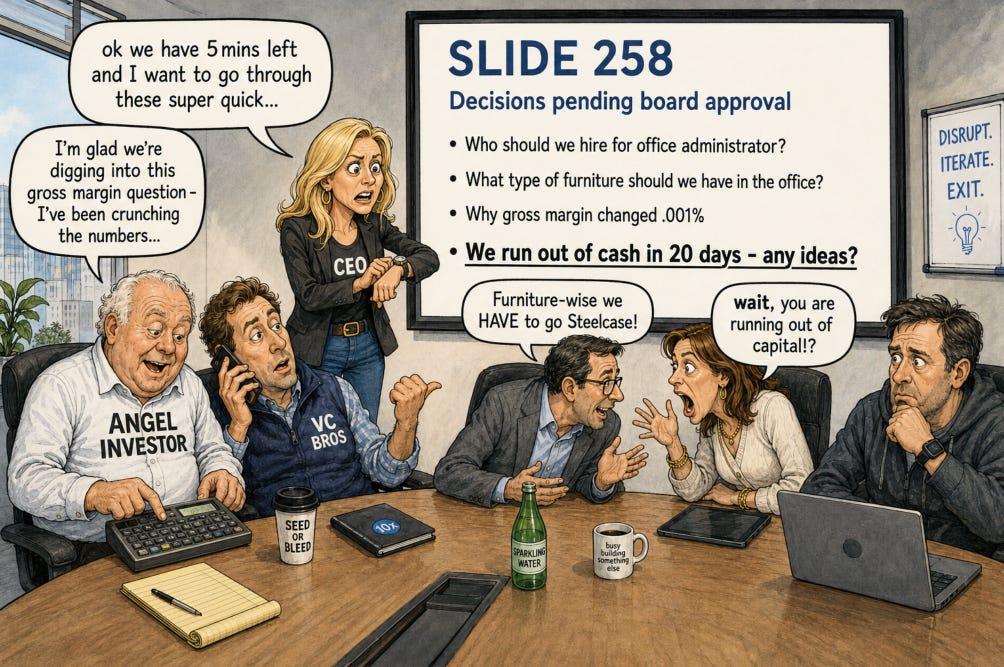
Across the ~250 board meetings I’ve attended, this by far is the most common problem depicted in the image above. The founder wants to ‘tell the complete story of the Q’ and paints this complicated 3hr picture of every part of the biz. Invariably the board asks a ton of questions and throws in a lot of random tactical ideas.
Suddenly, last slide, ‘board matters’ pops up and guess what, we’re out of time, but it’s suddenly revealed there’s a huge problem in the biz (buried the lede), we’re out of money, or there’s a big M+A discussion coming up.
My number one coaching for first time founders in their first 4 board meetings is to 100% flip this script. Literally put the last slide first, that’s all it takes. Yes the story gives context, yes it’s great to hear all that and learn more about all the details, but it’s super not productive and these boards get super sideways very quickly.
WNTD #2: Board Room Surprises!
Also depicted is the evil board room surprise. The most painful, chew your arm off to get out of it board meeting I was ever in was the first board meeting of a company that raised a big round and they revealed at the start (thank goodness) of the meeting they had missed plan by like 40-50% - something had changed in the biz during the closing and they hadn’t figured out what it was yet.
Even if you find out 5mins before the board meeting (rarely ever happens, lets face it) it’s always always always better to handle this:
Individual calls -start with your lead/big investor and work down the line.
This should have been in the materials, there were no materials
Don’t have a meeting without understanding the problem enough to present a ‘what we’re doing’ - you don’t have to solve it, but you have to a. know the problem and b. present at least a plan to have a plan.
WNTD #3: > 2HR Board Meetings
2hrs is the max, unless you are past series A. You don’t need committees, keep your board as small as possible - 3 is great, 5 is workable, 7 is not for early stage. If you’re 7 early stage, you are heading into 9 and 11 territory 😱😱😱😱😱😱
WNTD #4: Agenda-less board meetings
The words no board member wants to hear: “Hey guys, I thought for today’s meeting we’d just, you know, riff on the biz, talk about the vibes, really whatever you guys want to talk about….”
Nope. don’t do it.
WNTD #5: Treat Board like part of your Management Team
Robbie said it best: “Directors are not an ‘extra management team’. Give them context and a clear question - leverage their knowledge to help you.”
Putting it all Together Into a Handy Timeline
Here’s a handy timeline to think about. we’ll start at EOQ which is the end of the Q. Sitting here in late August, 2/3rds the way through Q3 we’re looking at an EOQ of 9/30.
EOQ - 7 - (sept 23 for example) - Email Board: “Hey we’re looking forward to the board meeting on XX/XX, I wanted to see if there are any topics you want to focus on. Last time we talked about GTM and I was going to update that, and preview our roadmap for the next 6 months, but we have flexibility if there’s anything else top-of-mind.
I remind everyone on the management team and any vendors in the critical path (it’s been 90 days) that we have a board meeting coming up and publish an internal schedule that has me ending out materials 72hrs before so I have a day of flex.
EOQ! GO Time - I start building the presentation, take the previous Q, dust if off, update the bones and get ready to pour in the results
I also start working with the GTM team on their piece, they should know all the key GTM KPIs at EOQ+1, if not, work on that.
I also start working with the Product team on their piece, it’s ‘known’ by eoq, so need to wait.
EOQ+7 - Hopefully less, but whenever your financial results (final P+L, cash, balance sheet, bookings, etc.) all come in, pour them into the deck
EOQ+9 - Internal solid first draft for team review
EOQ+12- Board package goes out
EOQ+14 - Board meeting!
This is tight, your finance function isn’t going to like EOQ+7, that’s fine, but the board meeting has to move out - anything beyond EOQ+21 starts to get weird because you are already 1/3 into the NEXT Q at the board meeting - you’ll naturally start to talk about customer wins in Q+1 and it gets messy fast. The actionability and impact goes down to the cube of the days pat EOQ+14 IMHO.
Bonus: Use AI to automate the busy work in here, AI is how you get your financial package to EOQ+7 or less, AI should pour that into your deck and YOU focus on the high-level story telling, and problem solving and communications vs. being in the weeds with tactical stuff.
Summary and Up Next…
To summarize, if you follow our four best practices and avoid our five what not to do’s, you should have much smoother and more productive board meetings. On top of that, these practices can roll forward in the investor/shareholder/team comms ‘waterfall’.
That brings us too next week’s post: “IR Comms waterfall step 2: Quarterly Shareholder Updates.”
Stay tuned and subscribe today so you don’t miss anything!
…Or…share with all your founder friends here→