

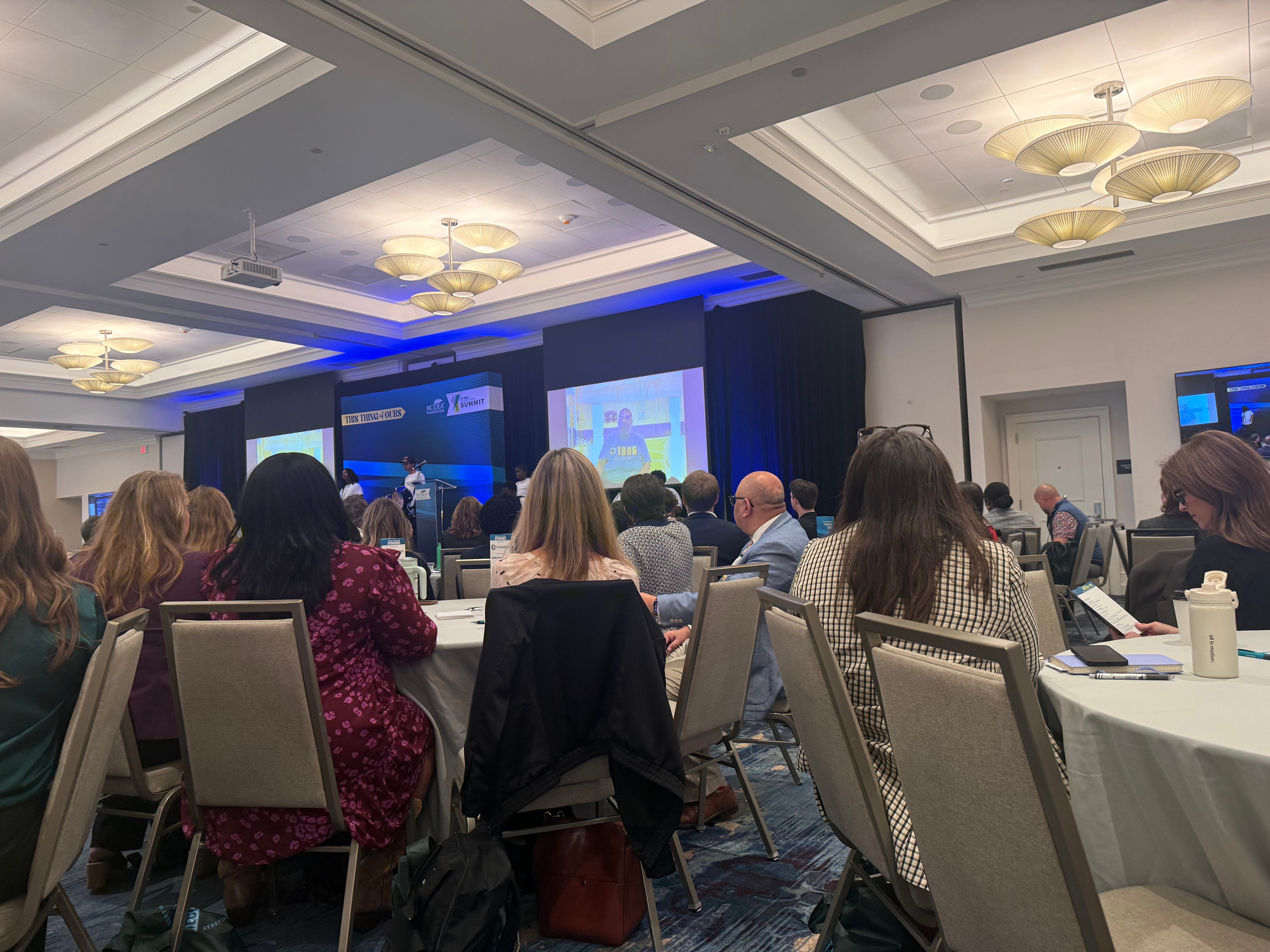
Malik Shabazz of Navigational Studios and his young drummers had rehearsed for about two and a half months. They filled the ballroom before anyone touched a microphone. Then Shabazz explained why it mattered. Drum line took him from age 8 to 18, then to a scholarship at Norfolk State University. He didn’t see a mountain until he was 19, on a bus through West Virginia.
His ask to the room had three parts. Invest in programs like his, which run short on sticks, equipment, insurance and gas money. Show up, so kids know someone cares about their future. And watch what happens next.
“It creates pride. And I said it before, it creates hope. You got a little bit of hope, you can change your trajectory.” — Malik Shabazz
NC IDEA President and CEO Thom Ruhe said he had wanted to open a summit with a drum line for eight years. He then explained the stakes. For many kids, marching band is the path to a college scholarship, and New Hanover County has no marching band. “Maybe we’ll figure it out by the ninth year,” he said.
That set the tone for the day: big ideas, real numbers, and a steady focus on who gets a shot. Here’s what happened on Day One.
Thanks to our sponsors for sponsoring this post:


Thom Ruhe: “Do the thing that creates more jobs”
Ruhe’s opening keynote had two modes. There was stand-up comedy, and there was a policy argument backed by data.
The comedy came first. He thanked sponsors by name and joked that entrepreneurship needs banks and lawyers. He gave a shout-out to the Manufacturing Solutions Center socks from the 2019 summit, which people still ask about. He also announced that he’d turned 60, and that his mom was in the room. Then he said he had to address “something big” from the previous week. The room tensed up, expecting the election. The punchline was the Bill Belichick breakup.
He also shared his leadership secret: “Hire people smarter than you.” He described a good board as “the barometer of courage of your organization.” And he credited former board chair Peyton with cutting board meetings from four hours to two, under a simple rule: no navel-gazing, just “money on the street.”
Then he got to the main argument.
The startup surge is real, and it isn’t fading. From January to September 2026, Americans filed about 4.93 million business applications, up 15.3% from the same period in 2025. September alone saw roughly 535,000. North Carolina is on pace for about 200,000 new business filings this year. Ruhe joked that the surge began around the time the summit did.
Young companies create jobs, and older companies cut them. Nationally, businesses under five years old added more than 1.8 million net jobs in 2025. Older businesses lost nearly 1.2 million. North Carolina followed the same pattern: young firms created 51,619 jobs while older ones shed nearly 40,000.
“The application, that’s just the starter’s pistol for a race that still has to be run. But the fact that a record number of people are getting to that point is something huge.” — Thom Ruhe
“If jobs is the coin of the realm,” Ruhe asked, “then do the thing that creates more jobs. Am I wrong?”
He then turned to recruitment incentives. The Economic Development Partnership of North Carolina has about 80 employees and a $50 million annual budget. NC IDEA runs on about $5.5 million a year with a staff of 12. Ruhe said the EDPNC team is among the best in the country, but he also pointed out that many big announced deals quietly fall apart later. His suggestion was simple: for every dollar spent chasing large companies, put a quarter into entrepreneurship.
He also shared NC IDEA’s own results:
1,185 grants totaling about $24.5 million in the last 11 years, compared with 121 grants for $4 million in the foundation’s first decade
775 grants worth $14 million made through ecosystem partners
66% of funding going to female, minority or rural founders
47 acquisitions in the portfolio, plus one public company, Guerrilla RF, which is preparing to uplist to Nasdaq
A record fall grant cycle, with more than 600 applications for MICRO and SEED grants
The biggest news was the release of the NC IDEA Playbook, a practitioner’s guide to the foundation’s model. Ruhe said NC IDEA is ready to take the model nationally. He invited other states to copy it as long as they contribute what they learn back. As he put it, consider it “joint custody.”
Ruhe added one caveat. Most states will need someone to write a $50 million to $100 million check first. He said NC IDEA’s status as an independent private foundation, with no state or federal funding, is what lets him “go where the data tells you to go,” including criticizing state incentive programs from the stage.
Entrepreneur Spotlight: SANDBAR Oyster Company turns cloth into reefs
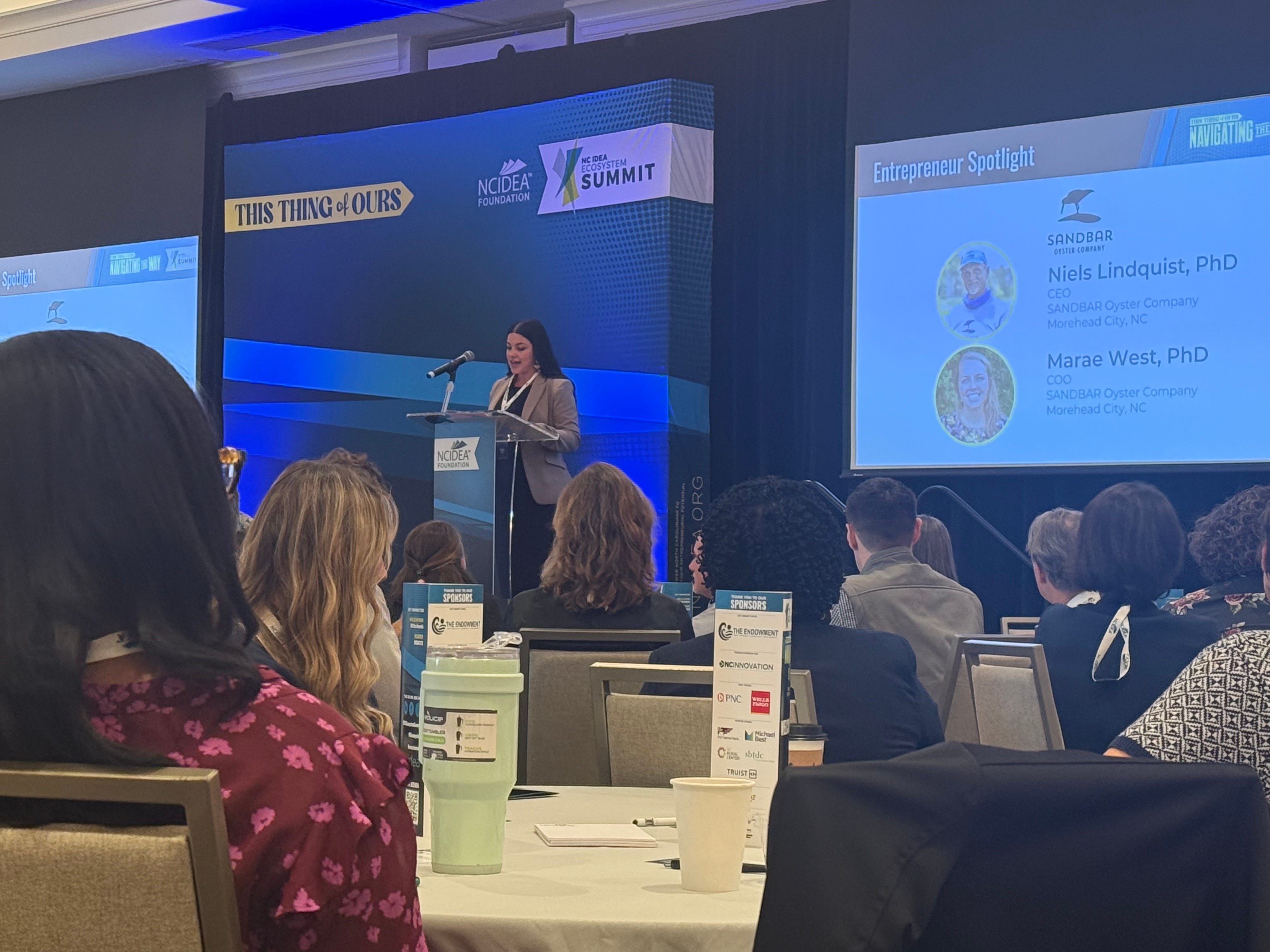
PNC’s Louisa Soto introduced the first spotlight with an oyster metaphor. The world may be your oyster, she said, but anyone who has tried to shuck one knows it takes skill, persistence and the right tools.
SANDBAR started with an unusual idea. Niels Lindquist, a UNC Chapel Hill faculty member at the Institute of Marine Sciences, teamed up with David Cessna, a Carteret County commercial fisherman known as “Clamhead.” Lindquist called them “the weird kids on the block,” more Far Side than Calvin and Hobbes. Their idea was to infuse cloth with cement, shape it, and let oysters settle on it.
The material, called Oystercatcher, worked. Oysters settled on it in large numbers. It also breaks down over time, which leaves the single oysters and small clusters that diners want. Lindquist described how the company got here, one partner at a time:
UNC’s Office of Technology Commercialization filed the patents. About $50,000 in technology development grants followed.
NC IDEA gave a $50,000 grant in 2016, right after Ruhe arrived. Lindquist called it “the step that really allowed us to survive.” SANDBAR has run on revenue ever since.
Pat Donovan-Brandenburg, Jacksonville’s stormwater manager, brought the company into her “oyster highway” project on the New River in 2018. That project is now entering its fourth phase.
The North Carolina Coastal Federation helped build the market for natural shoreline protection, which gave SANDBAR a market to sell into.
COO Marae West, Lindquist’s daughter, described what comes next. The company moved its factory to Leland to create local jobs. Everything there is built by hand. SANDBAR recently installed more than 1,000 linear feet of living shoreline at the North Carolina Aquarium and has shipped product to California. It holds patents in Australia, Canada and New Zealand, and it has launched a spin-off called SANDBAR Ecological Advising. New products in development include dock-piling cuffs for growing your own oysters, shell-rake protection for American oystercatcher nesting sites built with Audubon North Carolina, planted designs, and mussels.
Lunch Panel: “Nobody’s shooting at me”
The panel came one day after Veterans Day. Scott Davis, Wilmington Hub Director for NCInnovation, opened it with a line from veteran-focused investing: vets are good bets. Moderator Mel Wright of The Wright Village then led a conversation with two founders.
Rob Cooley (Nuream) is a West Point graduate and retired Army Brigadier General with 37 years of service. His father started a company using Rob’s college fund, so building companies runs in the family. Nuream started with a problem common among veterans: poor sleep. The company focuses on collecting “the right data,” not just more data, and uses sleep as its entry point into broader human health and performance. When people tell Cooley he seems calm under startup pressure, he tells them, “Nobody’s shooting at me.”
Scott Monroe (Essential Personnel) served in the Marine Corps and later became a Wilmington firefighter. He noticed that the military tracks a lot about each service member: skills, credentials, and how much trauma they’ve been exposed to. Fire and police departments often promote people based on a one-time test. Six years later, Essential Personnel serves about 200 public safety agencies in 31 states, including 92 in North Carolina. It has nearly 30 employees, and all of its engineers are U.S.-based.
Monroe also warned founders about raising too much money too early. He had watched a previous startup raise “way too much money at a stupid valuation.” He said taking money at the wrong time or the wrong valuation leaves you stuck.
Monroe’s story included plenty of difficult moments:
He went four and a half years without a salary and took out a mortgage on his house to fund the company.
Every dollar in the first five years went to customer success or engineering. In his words, there was “no kombucha on tap.”
Government sales cycles can run 18 to 24 months. One city deal took almost three years.
The hardest stretch is getting from about $200,000 to $1 million in annual recurring revenue. Banks won’t lend at that stage and VCs aren’t interested yet. NC IDEA’s $50,000 grant came during that stretch. “I would not be here if it wasn’t for NC IDEA,” he said.
The panel’s requests for the ecosystem were specific. Cooley asked for a dedicated pool of capital for veteran founders and for business training at the point of military transition. Monroe pointed to Fort Bragg, Camp Lejeune and Seymour Johnson as a major source of future founders. He also asked legislators to back startups over large corporate incentives. Cooley noted that veterans start roughly 45% of small businesses. Monroe ended with a pitch for founder-led companies over private-equity roll-ups. His advice: trust the HVAC guy who shows up in a beat-up old white van.
Mel Wright also told her own story. She bootstrapped The Wright Village with savings and income from her tax business. Before that, while running a resale clothing store, she once had to choose between paying her mortgage and paying the store’s rent. She paid the rent. She closed the panel with this:
“No entrepreneur should have to build alone.” — Mel Wright
Fireside with Dane Stangler: The data behind the boom
Wells Fargo introduced the session and noted its $500,000 contribution last year to NC IDEA’s rural entrepreneurship work. Then Dane Stangler, Senior Advisor at the Global Entrepreneurship Network and Ruhe’s former Kauffman Foundation colleague, gave the data-heavy talk of the day. He joked that it was exactly what everyone wanted right after lunch.
Stangler explained why advocating for startups in Washington is hard:
“Companies that don’t exist tend not to donate to political campaigns.” — Dane Stangler
His main point was about how much has changed. Ten years ago, economists described a “startup deficit,” and Inc. published a piece warning that American entrepreneurship was vanishing. Business creation then took off in mid-2020 and has stayed high. Recent years have run 60% to 80% above any point in the previous decade. Explanations like stimulus checks, remote work and pandemic-era quitting don’t account for it, because the surge has continued.
He also pointed to some concerning trends in the data:
High-propensity applications, the ones most likely to become employer businesses, have fallen from about 40% of filings a decade ago to just over 25% today. Most of the growth is in non-employer filings. Stangler argued those still matter, since about a third of new employer firms start out as non-employers.
Applications that state an intent to pay wages have fallen back to pre-pandemic levels or below.
AI is producing more businesses that are higher quality, but with fewer jobs per company. If the number of startups dips, overall job creation could drop with it.
Underrepresented founders are starting businesses faster than ever. Black Americans have shown the largest increase in entrepreneurship in recent years. But the companies that survive and scale are still mostly led by white men, largely because of gaps in financing and networks.
Ruhe then asked about immigrant entrepreneurship, which he said hasn’t been getting enough attention. Stangler’s answer was that immigrants start businesses at twice the rate of native-born Americans, and they founded roughly a quarter of today’s VC-backed unicorns. Ruhe’s view: anyone who claims to follow the data “would be embracing very pro-immigrant policies.”
The conversation also covered policy. Stangler noted that the 2025 tax law reversed the R&D expensing change that had hurt startups. Ruhe credited the Affordable Care Act with ending the “job lock” that kept would-be founders in their jobs. From the audience, repeat founder Allison Rosenberg said she left Microsoft to start her first company in 2015 only because ACA coverage made it possible.
Then Ruhe shared some numbers from NC IDEA’s own grant process. He estimated that 25% to 35% of the fall applications were “AI slop.” Some were clearly written by AI in the final 48 hours before the deadline, and some still had the prompt text in them. NC IDEA can’t use AI to screen applications because they’re confidential. His advice to future applicants: “at least edit out the prompt garbage.”
Ruhe also told a strange story to explain why. He recently got a mailer offering to pay him to ship old encyclopedias, service manuals and trade magazines going back to the 1950s. His colleague Carlo figured out the likely reason: AI companies have already scraped the internet, so now they’re buying print material that isn’t online. Ruhe said that’s why NC IDEA won’t run confidential founder applications through AI tools.
Ruhe also made one more announcement: NC IDEA now holds the registered trademark for “Ecosysteming.”
Asked what they would build with unlimited funding, the two gave different answers. Ruhe said he would fund every deserving applicant who falls just below the cutoff each cycle, calling the gap “lost economic impact for the state.” Stangler said he would reinvent entrepreneurship education at every level.
The best story of the session was about Arnav, an 18-year-old who stopped Ruhe on a stairwell at a youth entrepreneurship event when he was 16. Arnav told him he probably wouldn’t finish high school because “the entire world’s knowledge is right here,” and held up his phone. At 17 he left school for a job at a Techstars-backed startup in Silicon Valley. He later made a deal with his school to graduate, and then got a job at Palantir. Now he plans to spend a year or two at Pomona College:
“I want to learn how to think. I think the biggest challenge in my generation is we don’t know how to think.” — Arnav, as told by Thom Ruhe
Ruhe recommended Arnav’s episode of the Ecosysteming podcast to everyone in the room.
Ruhe also explained how NC IDEA changed who it funds. When he started 11 years ago, more than 90% of grants went to white men in the Triangle. Now almost 70% of funding goes to female, minority or rural founders. Good intentions alone didn’t change the numbers. What did was the MICRO grant program, designed for founders who lack the networks to get to seed stage.
The final question came from Laura Adams of Kindly Woven, based in an eastern North Carolina county with very high child poverty. She asked what’s being done for her region. Ruhe pointed to a $10 million Golden LEAF Foundation grant that will take NC IDEA’s full portfolio to rural counties statewide, and said more details would come on Day Two.
Innovation as an Economic Development Strategy
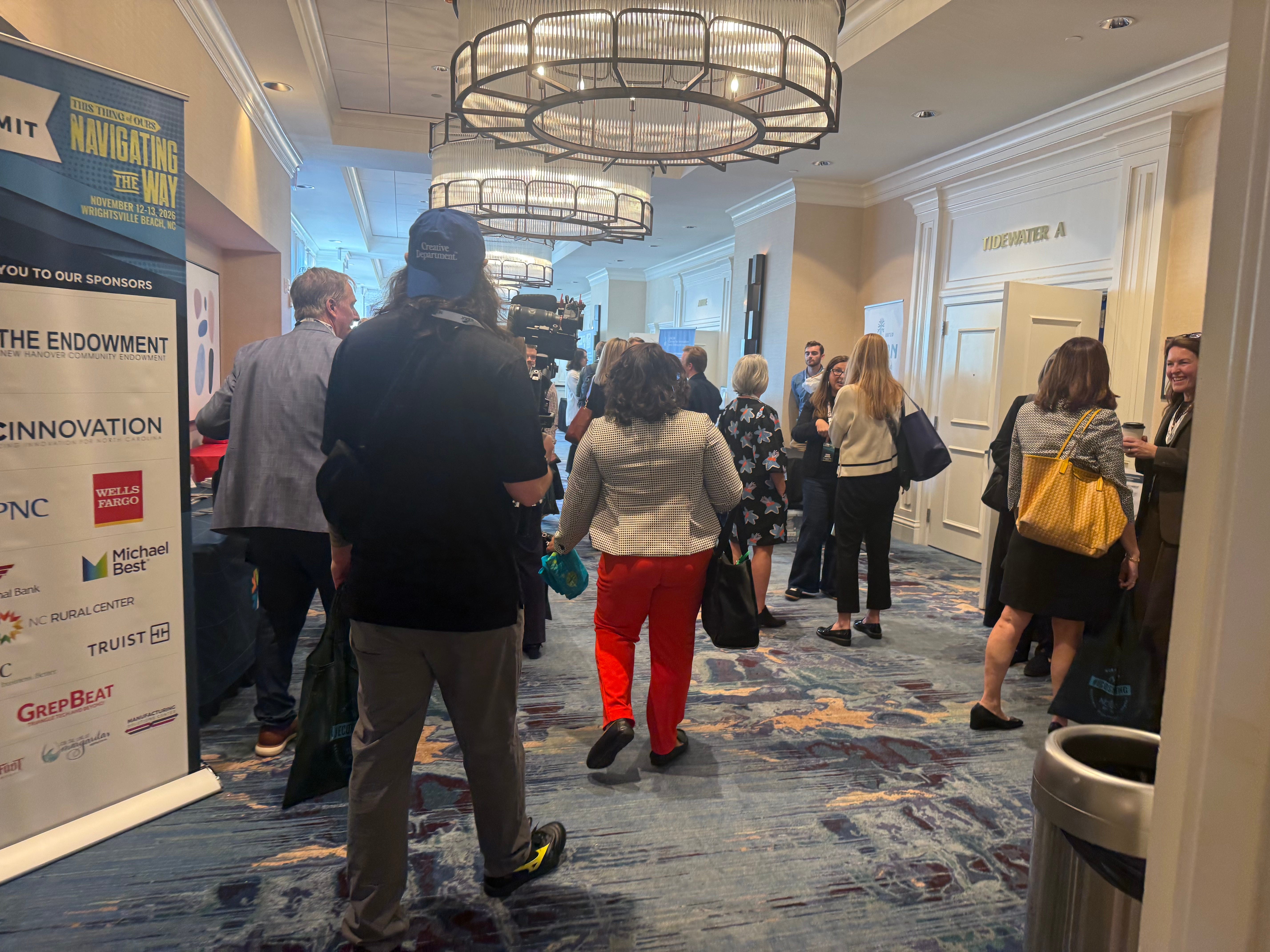
SBTDC’s Frank Carter opened by honoring John Liuari. Liuari is retiring at the end of the year after 25 years leading SBTDC’s technology commercialization team, and Neil McTigue takes over in January. Carter said that if a North Carolina company won an SBIR or STTR award in the past two decades, John probably had a hand in it.
Moderator Paul Corson of the National Academy of Inventors said he has followed North Carolina since 2006. When he studied Italy for a Commerce Department project, its coastline, agriculture, manufacturing and artisans reminded him of North Carolina.
Michelle Bolas, NCInnovation. Bolas started by correcting a common misconception: NCInnovation does not have $500 million to spend. The General Assembly lets it use the investment returns on a $500 million state reserve, which comes to about $25 million a year. Since its first funding round in 2024, NCInnovation has awarded $45 million to 55 technologies across all five regions of the state. The Research Triangle has the fewest of those projects. The work has produced 26 spin-out companies. NCInnovation also puts about $10 million a year into a regional ecosystem program run by eight hub directors.
Her main argument was that technology-based economic development does not depend on big cities. Clusters tend to form around anchor institutions such as universities and community colleges. That points to marine and ocean tech on the coast, and to batteries and rare-earth minerals in the Piedmont Triad. Bolas also said company recruitment and startup clusters reinforce each other. Toyota’s battery plant has spurred battery research, and a strong startup cluster becomes a selling point for recruiting companies. Her message to policymakers: “Don’t kill it before you get to those results.”
She also pointed out an opportunity many people overlook. European small and mid-sized businesses are already working with North Carolina university researchers to enter U.S. markets. Few North Carolina companies are doing the same.
Sean Wilkerson, USPTO. Wilkerson becomes director of the USPTO’s new Raleigh Community Engagement Office on December 13. He laid out the free and low-cost resources available to founders:
Patent and Trademark Resource Center at NC State, which helps inventors run proper prior-art searches. He said that nine times out of ten, a “new” idea already exists in some form.
Pro bono law clinics at UNC Chapel Hill and North Carolina Central University
Micro-entity status, which cuts patent fees by 80% for eligible inventors
Provisional applications, a low-cost way to hold your place in line
Free programs anywhere in the region. If virtual won’t work, he said, the office will come to you at its own expense.
He also covered how long things take. First action on a patent currently takes 18 to 20 months, and a final decision can take two and a half years or more. On AI, he said AI cannot be listed as an inventor or author, and that the office is still working through many related questions.
Wilkerson also made the point that the process is more approachable than people think. He has worked with high schoolers who filed and received trademarks using only the USPTO’s free online courses. “A 16-year-old can do it,” he said. He also noted the office’s growing work on name, image and likeness. In a basketball state, young athletes, creators and influencers increasingly need to protect their personal brands, especially now that AI makes it easy to imitate someone’s likeness. “Your brand can be your business,” he said.
Corson added some history. Patents are written into the Constitution as a temporary monopoly meant to bring commercial value to society. He said patent holders should keep that original purpose in mind.
Wilmington’s “Family Tree” of Entrepreneurship
This was the hometown panel, and the room clearly enjoyed it. Moderator Jim Roberts of the Network for Entrepreneurs in Wilmington started with a few local stats. Wilmington was recently named one of the South’s top 15 tech hubs. It ranks top five nationally in total job growth over the past decade and third in white-collar job growth. Its 1 Million Cups chapter now draws about 100 people every Wednesday at 9 a.m. Roberts’s message: Wilmington isn’t just a weekend beach town.
His main point was that Wilmington now has a flywheel. Live Oak Bank produced nCino. Employees from both companies are starting their own ventures, and Live Oak’s founders are investing in them.
Kay Anderson, Live Oak Bank. Anderson was employee number 20 and the bank’s first female employee. The founders wrote the business plan in 2006 and spent a year, from May 2007 to May 2008, convincing regulators to approve a bank that would focus narrowly on a few industries. They opened just a few months before Lehman Brothers collapsed. The bank’s first customers were veterinarians, and it was briefly nicknamed “the doggie bank.” Live Oak hired veterinarians as in-house experts to spot what the financial statements missed.
Today Live Oak lends in about 30 industry verticals and has been the country’s largest SBA lender by volume for 14 years. Anderson’s favorite verticals are chicken farmers, senior care and hotels. She summed up the approach as high tech and high touch. Employees are taught to return every call the same day by phone, not by text. Live Oak and its related companies have hired about 1,000 UNCW graduates.
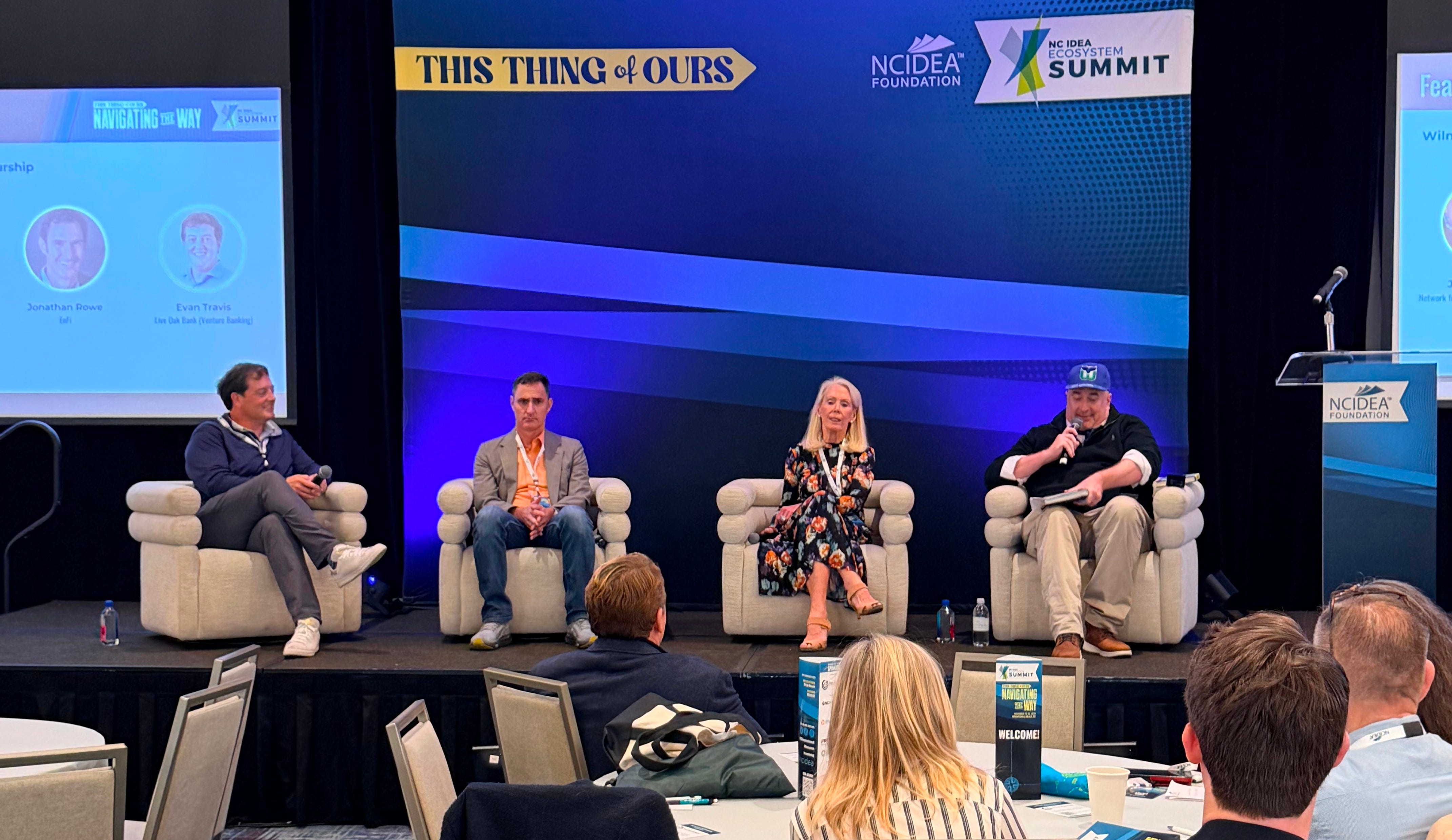
Jonathan Rowe, EnFi (and an early nCino leader). Rowe used to teach entrepreneurship at UNCW and once ran a pitch event where someone brought a horse into the dining hall. He left a newly tenured faculty job to join a software company that didn’t have a name yet. That company became nCino, which started as a tool to solve Live Oak’s own loan-processing problems. nCino planned to go public in April 2020. COVID froze the IPO market, and nCino went public that summer anyway, the second big IPO after the pandemic hit. Rowe said the part he remembers most is the effect on people. One colleague who joined right out of college had paid off her student loans and her house by age 32. An Uber driver once thanked him because his business depended on driving visitors to Live Oak and nCino.
Rowe also mentioned that the chancellor left him a voicemail the morning after the horse showed up in the dining hall. “You gotta push the envelope,” he said. Roberts brought a prop: one of the bells nCino gave employees on IPO day. He rang it during the panel and promised to return it to its owner.
Evan Travis, Live Oak Venture Banking. Travis described the next generation of companies. Live Oak has made 15 equity investments from its own balance sheet. It is also a founding partner of Canopy Ventures, which manages $1.6 billion across two funds. The two have different strategies:

Travis’s main point was that founders should understand exactly what an investor is looking for before they pitch.
Stronger Together: When ESOs “ecosystem too hard”
The last panel covered a trend that has picked up in North Carolina this year: entrepreneur support organizations (ESOs) merging. Moderator Rachael Newberry has been through one herself. Earlier this year she and Tom Snyder brought RIoT’s programs into NC IDEA through a joint venture with the Wireless Research Center.
Innovate Charlotte and Launch CLT announced their merger in October. Juan Garzón said the two organizations had the same mission and served the same founders, and founders were already moving back and forth between their programs. Erica Madden said each side brought something the other lacked. Launch CLT had a strong mentor network, and those mentors now facilitate Innovate Charlotte’s programs. Madden also shared a lesson from the nonprofit world: groups with the same mission often don’t combine forces enough, because of ego and because founders’ names are on their organizations.
David Whitmire of the Wireless Research Center had the busiest year of the three. He described it as “creative destruction” in a maturing ecosystem. Besides the NC IDEA joint venture, the Wireless Research Center is:
Acquiring the 200-acre Pisgah Astronomical Research Institute for RF-quiet testing, in partnership with Western Carolina University
Running a DARPA commercial accelerator, which was recently named Accelerator of the Year
Bringing Idaho National Laboratory quantum-sensor testing to western North Carolina, and working with Duke on quantum sensing and communication
Building toward a $1 billion pool of capital for dual-use technology, with $250 million committed so far
Whitmire’s main lesson was about mission: “When revenue becomes the mission, you’ve lost your way as a nonprofit.” He also argued that North Carolina’s geography is an asset for defense testing. The state is four hours from the Pentagon, has a temperate rainforest in the west, and has coastal waters he said resemble the Taiwan Strait.
The panelists agreed on the hardest part of merging: combining systems. “I forced Juan to switch to Gmail,” Madden said. “That was my big win.” Newberry said moving data between Google Drives was one of the biggest headaches.
Congratulations to the new grantees
The day closed with NC IDEA’s MICRO and SEED grant announcements. Congratulations to the 22 companies chosen from a record 600+ applications this fall, and welcome to the NC IDEA portfolio. We can’t wait to see what you build.
And to everyone who just missed the cutoff: Ruhe made a point of saying the next applicant below the line is usually just as deserving. Come back next cycle.
Five takeaways from Day One:
The startup surge is lasting. It has gone on for five years, and North Carolina is ahead of the national numbers.
Young firms create net new jobs. Ruhe argued policy should follow that data, starting with a quarter into entrepreneurship for every recruitment dollar.
Early, non-dilutive capital matters. Both SANDBAR and Essential Personnel credited an NC IDEA grant with getting them through a critical stretch.
AI cuts both ways. It makes founders more productive and it floods grant programs with low-effort applications. It may also mean fewer jobs per startup.
The ecosystem is maturing. Organizations are merging, Wilmington’s companies are spinning out new ones, and NC IDEA is sharing its playbook with other states.
Coming up on Day Two: a welcome from Sophie Dagenais of the New Hanover Community Endowment, the Youth Summit Pitch Competition, a panel on North Carolina’s three NSF Engines, Senator Michael Lee, a fireside with Golden LEAF’s Scott Hamilton about the $10 million rural grant, an Entrepreneur Spotlight on Renaissance Fiber, the NC Tweener Fund lunch panel, and Ruhe’s closing remarks, which he promised would include “a big announcement.”
Day Two recap coming soon. Subscribe so you don’t miss it.