

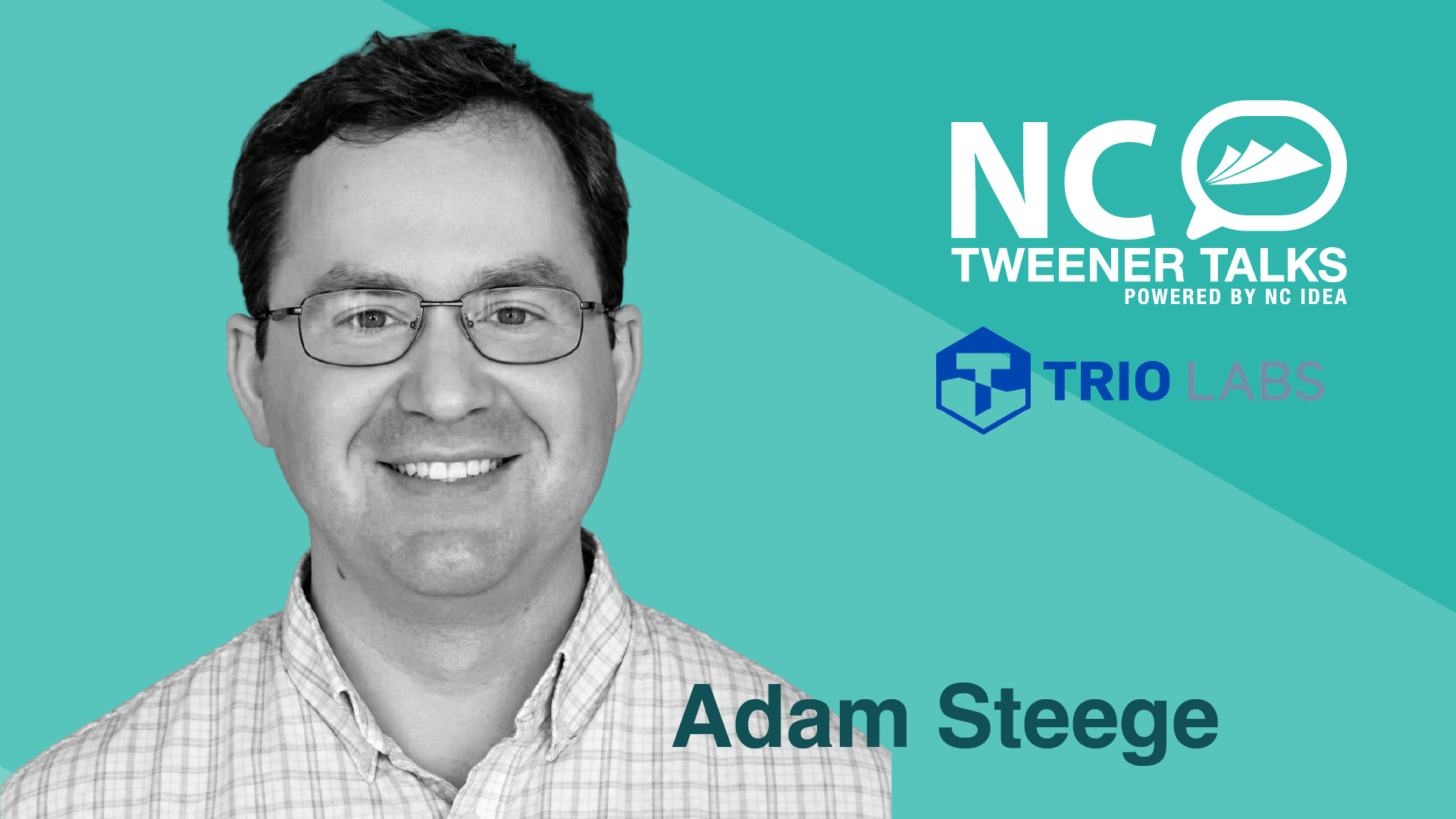
This episode leans heavily into the company. I sit down with Adam Steege, founder and CEO of Trio Labs, a Morrisville-based additive manufacturing company that 3D prints super-small, complex metal parts for medical devices. This episode is part of my ongoing series on North Carolina companies building in the physical world, and Trio Labs might be the most literal example yet, since they build the printers that print the other physical things. Along the way, Adam shares real founder lessons on failure, focus, and how a mechanical engineer talked himself into running a company.
We couldn’t bring you 100% original founder-to-founder content like this without the support of our awesome-sauce sponsors:
Loving our content? It wouldn’t be possible without our amazing sponsors and our paid subscribers, so THANK YOU!
Featured Platinum Sponsor

Featured Gold Sponsor

Featured Silver Sponsor

NC Tweener Times is a reader-supported publication. To receive new posts and support my work, consider becoming a free or paid subscriber.And special thanks to our friends at Walk West for partnering with us to produce this pod!
Who is Adam?
Adam Steege is the founder and CEO of Trio Labs, a Morrisville, NC company that does micro-scale metal 3D printing for medical devices. He grew up in North Carolina, left for six years to study math, physics, and mechanical engineering across a dual program at Carleton College and Columbia University, then came back home. Trio Labs is Adam's second company; his first was a med-tech startup building laparoscopic surgical devices, which grew directly out of his undergraduate senior design project. He ran that company for five to six years, getting through early animal trials before it stalled out on a classic med-tech problem: the people with the need weren't the people with the buying power. He founded Trio Labs in 2015, spent roughly five years getting the core technology to proof of concept, raised a Series A in 2021, and launched commercially in early 2023.
Highlights
Second time’s the build: Trio Labs is Adam’s second startup. His first, a laparoscopic surgical device company born from his college senior design project, ran for five to six years and reached early animal trials before stalling.
The failure that taught him the lesson: Adam calls it a “stakeholder visibility mismatch”: the people who felt the problem most weren’t the people with the power to buy, acquire, or partner. Now, he pressure-tests stakeholder alignment early in every venture.
The tech he wished he’d had: Trio Labs came directly out of Adam’s first startup. He wanted to 3D print metal components for medical devices, but the existing technology simply couldn’t deliver the performance he needed.
The timeline: Founded in 2015. Roughly five years to bench-scale proof of concept. Series A in 2021. Commercial launch in early 2023. Now rolling out the “Gen 3” industrial printer.
“Half ASML, half TSMC”: That’s Adam’s description of Trio Labs. The company builds ultra-precision printing equipment and operates it, selling finished parts as a service rather than selling the machines themselves.
The HP analogy: A Trio advisor, formerly president of HP’s 3D printing division and previously head of its ~$24 billion inkjet business, taught Adam that “the third dimension is nonlinear.” Moving from 2D to 3D printing introduces layers of complexity you don’t see coming.
Why metal, not plastic: Plastics already have cheap, mature manufacturing methods like injection molding and micro-molding. Metal doesn’t scale as easily with legacy processes, creating a “blue ocean” opportunity, especially when devices require mechanical strength or electrical conductivity.
A wafer fab in a box: Trio’s printers are roughly the size of a large refrigerator. Adam points out the same irony seen in advanced semiconductor equipment: the smaller the part you’re trying to make, the bigger and more sophisticated the machine becomes.
Two core markets: Robotics and endovascular devices, particularly flexible guidance systems for dexterous control through the body and the “business end” tools that perform procedures, such as biopsy instruments.
The go-to-market bet: Trio Labs sells parts, not printers. Additive manufacturing systems can cost $100K to $500K and sometimes seven figures, making them a tough sell for an unproven application. Selling parts lets engineers test the value immediately for a few thousand dollars instead.
Staying in the lane: Adam is deliberate about focus. He’s watched additive manufacturing companies spread themselves across oil and gas, aerospace, defense, and consumer markets, only to become mediocre everywhere. Trio Labs is staying focused on med tech.
Eleven years, one failed company, and a printer the size of a refrigerator later, Adam's build is finally reaching real patients, proof that in hardware, the founders who last are the ones who stay stubbornly focused. Enjoy the conversation.
Where to Watch/Listen:
Visit Tweener Talks to listen for all audio podcast players
We have a video version on YouTube (make sure to subscribe!)
📌 What’s Next
Subscribe to NC Tweener Talks for more conversations with North Carolina founders, operators, and builders shaping the future of the ecosystem. Paid subscribers help us keep creating more episodes, events, and founder-focused content across the state.